

Most lists of CRMs for marketing agencies mix two different kinds of software, one that tracks the clients you want to win and one that tries to hold the whole agency. Pick from the wrong group and you pay for a tool your team stops opening.
The best CRM for marketing agencies depends on the job. To track your own new business and client leads, pick a sales CRM such as Fluid CRM ($16 per seat a month, teams of 1 to 10), Pipedrive or HubSpot. For client portals, white label or project delivery, pick GoHighLevel or monday CRM.
New business stalling during delivery weeks?
Fluid CRM keeps your own pitches and each client’s leads in separate pipelines and tells you each morning who needs a follow-up.
No card needed
Sales CRM Or Agency Operating System?
- You need a sales CRM to track your own new business, your renewals and your clients’ leads.
- You need an agency operating system if you want client logins, your brand on the software or project delivery in one tool. Go to GoHighLevel or monday CRM.
Fluid CRM is the first kind, an agency CRM for teams of 1 to 10.
- Choose Fluid CRM if you are 1 to 10 people and want your own sales and each client’s leads in separate pipelines, at $16 per seat a month.
- Choose HubSpot if you sell inbound marketing and want marketing automation beside the pipeline, from $20 per seat a month.
- Choose Pipedrive if you are a sales-led agency that wants email sync and automations, from $24 per seat a month.
- Choose GoHighLevel if you want each client in their own account, from $97 a month for 3 client accounts.
- Choose monday CRM if you want the sale and the delivery on one board, from $18 per seat a month.
The 9 Best CRMs For Marketing Agencies At A Glance
| CRM and plan | Best for | 5 seats a month | 10 seats a month | Client leads | Delivery tools | Portal or white label |
|---|---|---|---|---|---|---|
| Fluid CRM, one plan at $16 per seat | Own sales and client leads, 1 to 10 people | $80 | $160 | Yes, a pipeline per client | No | No |
| HubSpot Sales Hub, Starter at $20 per seat | Inbound agencies, any size if you sell HubSpot | $100 | $200 | Yes, separate pipelines | Not included | Not included |
| Pipedrive, Lite at $24 per seat | Sales-led agencies, 3 to 20 people | $120 | $240 | Yes, unlimited pipelines | Paid add-on | Not included |
| GoHighLevel, Starter at $97 flat | Agencies giving clients accounts, any size | $97 | $97 | Yes, an account per client | Calendars, invoicing and payments | Reselling at $497, portal app $49 extra |
| monday CRM, Basic at $18 per seat | Project-based agencies of 3 or more | $90 | $180 | Yes, unlimited pipelines | Boards, quotes and invoices | Free viewers |
| Zoho CRM, Standard at $20 per seat | Custom setups, 3 or more people | $100 | $200 | Yes, several pipelines | Not included | Portals on Enterprise, $50 |
| Capsule, Growth at $40 per seat | Two-person agencies starting free | $200 | $400 | Yes, on Growth | Project boards | Not included |
| Salesflare, Growth at $39 per seat | Inbox-led agencies, 1 to 10 people | $195 | $390 | Pro limits users to chosen pipelines | Not included | Not included |
| Google Sheets | One person | $0 | $0 | A tab per client | No | Share the file |
Each tool is priced on monthly billing, on its entry paid plan or the first plan with more than one pipeline.
The two right-hand columns are where Fluid CRM says no. If those are the columns you care about most, the answer for your agency is further down the table.
How Each CRM Was Judged For Agency Work
A marketing agency does not sell the way a software company does. It wins a client, keeps that client for months or years and often manages leads on the client’s behalf. So each CRM on this list was judged on five things an agency does every week.
Your own new business
The whole team should see every prospect, every proposal and the next step on one board. A media agency with three people pitching needs one shared view, because a deal that lives in one person’s inbox is invisible to the other two.
Leads from the campaigns you manage for clients
Advertising and paid ads agencies send leads to clients every day. The question is whether each client’s leads can live in their own pipeline and what the client gets to see.
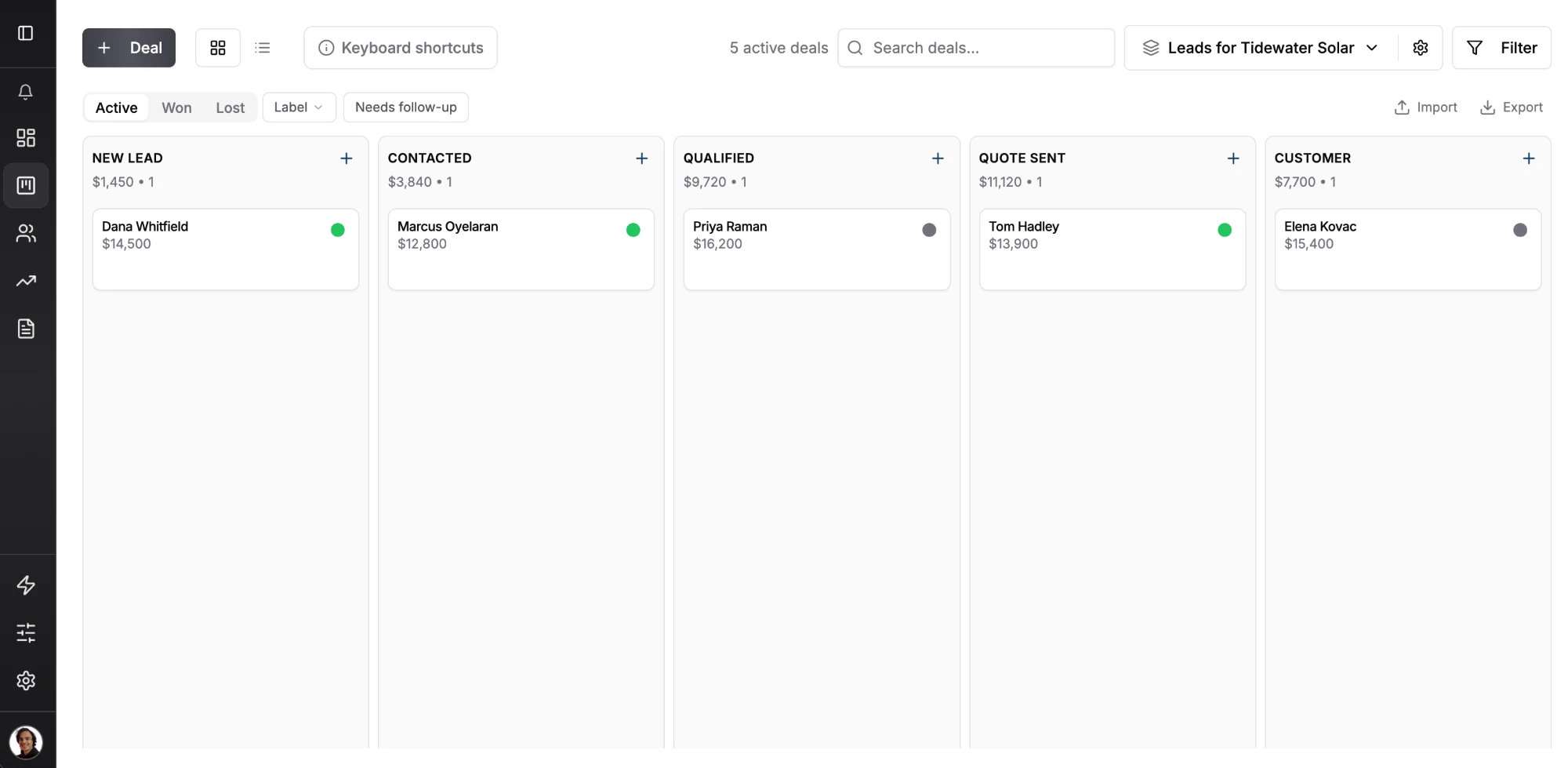
Fluid CRM gives you a separate pipeline per client inside one workspace. It does not have a separate workspace per client, so everyone on your team sees the same contacts.
Retainers and renewals
Agencies sell a monthly relationship, so the tool has to hold a monthly value and a renewal date, and it has to remind someone before that date arrives.
The handoff to delivery
On the day the deal is won, in some tools the deal becomes a project on the same board, and in others the client’s details leave the CRM and go to a project tool.
What a seat costs when freelancers come and go
Per-seat tools charge for every login. Seat minimums and seat bundles round a small team up, and a flat price ignores headcount completely.
Where these five came from
Around 10 of the clients of Fenixtal, my agency, were marketing agencies, and I watched most of them struggle with their CRM. One was a podcast marketing agency that kept its pipeline in Salesforce, and the CEO asked me to add a simple kanban view for the team.
I expected 30 minutes and it took five hours. A deal could not exist until I had created the organization as its own record and then the contact as another, and the finished board was locked to me until I worked out the permissions for a 4-person team.
That afternoon is why setup and update speed sit under every criterion here. Can you name every client whose contract ends in the next 90 days without opening a spreadsheet?
The 9 Best CRMs For Marketing Agencies
1. Fluid CRM (best for agencies of 1 to 10 tracking their own sales and client leads)
We built Fluid CRM after watching agencies give up on CRMs that took too long to update. It opens on a visual pipeline, a new deal takes a few seconds to add and the contact and company are created from the deal.
Verdict: Fluid CRM is a sales CRM for marketing agencies of 1 to 10 people, at $16 per seat a month, that holds the agency’s own sales pipeline and a separate pipeline for each client’s leads. It is not an agency operating system, so it has no client portal, no white label, no project management, no invoicing, no proposals and no workspace per client, email is logged by BCC only and a deal holds one contact.
Price: $16 per seat a month or $144 per seat a year. There is one plan with every feature in it, and a 7-day free trial with no credit card required.
Best for: Agencies of 1 to 10 people that track their own new business and the leads they generate for clients.
Cost for 5 seats: $80 a month, or $720 a year on annual billing.
Setup: You import contacts and deals from a spreadsheet and set your own stages. A G2 reviewer in marketing and advertising wrote “I was up and running in minutes.”
What agencies get with Fluid CRM
What agencies like: Unlimited pipelines and custom fields, a reminder on each deal with a daily email digest, lead capture forms, reports and a forecast with a 3-month projection. There is an API with webhooks, and a connector that lets Claude and ChatGPT find deals, add notes and set reminders.
Nicolas Virtsonis, who runs a specialist B2B marketing agency, put it this way in his review: “It offers 90% of what most CRMs offer while only using about 20% of the time it takes when using them.”
He had tried a long list before it. “I’ve tried many CRMs over the years… Sugar, Zoho, Pipedrive, Salesforce, ActiveCampaign, Vtiger and custom systems. They are all overly complex and simple entries take up your time.”
What Fluid CRM does not do
Where it falls short: Everything in the verdict above, and everyone on the team sees the same contacts. There is no automatic email sync, no calendar sync, no marketing automation or no dialer.
Nicolas says the same in his own words: “I would say the only negative is perhaps the current lack of certain features that someone may need.”
2. HubSpot Sales Hub (best for inbound agencies that want marketing automation)
HubSpot is the name most agency owners hear first, and many agencies that sell HubSpot work to clients use it themselves. The pipeline, the contact records and the marketing tools share one database.
Verdict: HubSpot Sales Hub is the pick for an agency that sells inbound marketing and wants marketing automation beside its pipeline, from $20 per seat a month on Starter. The features most teams upgrade for sit on Professional at $100 per seat a month plus a required one-time onboarding fee of $1,500.
Price: Free for up to 2 users. Starter is $20 per seat a month, Professional is $100 per seat a month on an annual commitment and Enterprise starts at $150 per seat a month with a $3,500 onboarding fee.
Best for team size: 10 people or more, or any size if HubSpot is what you sell.
Setup: Starter needs no paid onboarding. Professional and Enterprise both come with the required onboarding.
What agencies like: One record for marketing and sales, strong reporting and a free plan to start on. Starter allows up to 15 pipelines per account, so new business, renewals and client leads can each have their own.
Where it falls short: Marketing automation is a separate product with its own price. The step from Starter to Professional is five times the seat price. We compare the two most common picks in Pipedrive vs HubSpot.
3. Pipedrive (best for sales-led agencies that want email sync built in)
Pipedrive is built around a drag-and-drop pipeline and has been for years. Agency owners describe it as the simple, visual option for tracking their own new business.
Verdict: Pipedrive is the pick for a sales-led agency that wants a visual pipeline with two-way email sync and automations, from $24 per seat a month on Lite. The sync and the automations start on Growth at $49 per seat a month.
Price: Lite $24, Growth $49, Premium $79 and Ultimate $99 per seat a month. There is no free plan, and the trial is 14 days.
Best for team size: 3 to 20 people.
Setup: No required onboarding and no seat minimum. Pipelines are unlimited on every plan.
What agencies like: The board is fast to learn, emails sync both ways from Growth and there are plenty of integrations. A project tool exists as a paid add-on and is included on Premium and Ultimate.
Where it falls short: Lite logs email by BCC, and two-way sync starts on Growth at about twice the entry price.
4. GoHighLevel (best for agencies that give each client an account)
GoHighLevel, which now calls itself HighLevel, is a marketing platform with a CRM inside it. Each client gets a sub-account with its own pipeline, funnels, calendars, email and SMS.
Verdict: GoHighLevel is the pick for an agency that wants each client in their own account, at $97 a month flat for 3 client accounts and $297 a month for unlimited. Reselling the software under your own brand is not part of either plan and needs SaaS Mode on Agency Pro at $497 a month. Our guide to GoHighLevel pricing adds the usage costs for an agency with several clients.
Price: Starter $97, Unlimited $297 and Agency Pro $497 a month, each with unlimited users and unlimited contacts. Phone numbers, SMS, emails sent and premium AI are billed by usage on top.
Best for team size: Any, because the price does not change with headcount.
Setup: A 14-day trial on every plan, and a library of pre-built accounts for different industries to start from.
What agencies like: Unlimited users and unlimited contacts on every plan, so adding a freelancer costs nothing. A branded client portal app is a paid add-on at $49 a month per sub-account.
Where it falls short: It is a lot of software if the job is tracking your own deals. Agency owners say it suits the agency model and call it more of a marketing tool than a sales CRM. We sorted the options by what you use it for in our list of GoHighLevel alternatives.
5. monday CRM (best for project-based agencies that want sales and delivery on one board)
monday CRM sits on top of monday’s work boards. That makes it the natural pick when a won deal should turn into a project in the same tool.
Verdict: monday CRM is the pick for a project-based agency that wants the sale and the delivery in one place, from $18 per seat a month on Basic with a 3-seat minimum. Two-way email with Gmail and Outlook starts on Standard at $25 per seat a month.
Price: Basic $18, Standard $25 and Pro $41 per seat a month. On annual billing those are $12, $17 and $28.
Best for team size: 3 people or more.
Setup: Seats are sold in sets of 3, 5 and 10, so a team of 4 pays for 5 and a team of 7 pays for 10. The trial is 14 days.
What agencies like: Unlimited pipelines on Basic, quotes and invoices on every plan (20 a month on Basic) and unlimited free viewers, which helps when a client only needs to look.
Where it falls short: Basic allows 5 columns per board and 1,000 contacts. Mass emails and email sequences are on Pro.
6. Zoho CRM (best for agencies that want the most customizing for the price)
Zoho CRM gives you a long list of features on a low plan and lets you change almost all of them. It suits an agency with one person who enjoys setting a tool up.
Verdict: Zoho CRM is the pick for an agency that wants deep customizing on a small budget, from $20 per user a month on Standard. Client portals start on Enterprise at $50 per user a month.
Price: Free for 3 users. Standard $20, Professional $35 and Enterprise $50 per user a month, or $14, $23 and $40 on annual billing.
Best for team size: 3 people or more, with one of them owning the setup.
Setup: Standard includes several pipelines, forecasting and workflow rules. It allows 10 custom fields per module, and Professional raises that to 155.
What agencies like: The price for what is included, and a wider family of Zoho products for projects, invoicing and email when the agency grows into them.
Where it falls short: The free plan has one pipeline. Webhooks start on Professional and portals on Enterprise, so the plan you need depends on which one feature you cannot do without.
7. Capsule (best free start for a two-person agency)
Capsule is a contact-first CRM with a free plan that is a real product. Two founders can use it for nothing until they outgrow the contact limit.
Verdict: Capsule is the pick for a two-person agency that wants a free plan, with 2 users and 250 contacts at no cost. Growth at $40 per seat a month is the plan with more than one pipeline, automations and email sync.
Price: Free, then Starter $22, Growth $40 and Advanced $60 per seat a month.
Best for team size: 2 people on the free plan, up to about 10 on Growth.
Setup: The free plan has 1 sales pipeline, and the trial of the paid plans is 14 days with no card.
What agencies like: Project boards come with the CRM, so a won client can be tracked through delivery without a second tool. Growth includes multiple project boards and multiple sales pipelines.
Where it falls short: An agency that wants a new business pipeline and a renewals pipeline starts at Growth, which is the highest entry price in this list at 5 seats.
8. Salesflare (best for agencies that want emails logged for them)
Salesflare works inside Gmail and Outlook and fills itself in. It logs your emails, meetings and calls against the right contact without anyone typing.
Verdict: Salesflare is the pick for an agency that lives in its inbox and wants emails, meetings and calls logged for it, from $39 per user a month on Growth. Email sequences and user permissions are on Pro at $64 per user a month.
Price: Growth $39, Pro $64 and Enterprise $124 per user a month. Enterprise has a 5-user minimum.
Best for team size: 1 to 10 people.
Setup: A 30-day trial with no credit card, and no minimum on Growth or Pro.
What agencies like: The automatic logging. PR agencies and anyone whose sales happen over long email threads get a full history without extra work. Fluid CRM does not do this, because it logs email by BCC only.
Where it falls short: Limiting a user to specific pipelines is a Pro feature, so keeping one client’s leads away from a freelancer costs the higher plan.
9. Google Sheets (best for one person with a handful of open deals)
Google Sheets is still what many agency owners answer when someone asks which CRM they use. For one person with a few open deals it is a fair answer.
Verdict: Google Sheets is the pick for a solo agency owner with a handful of open deals, and it is free with a Google account. It stops working when a second person edits the pipeline or a renewal date needs a reminder.
Price: Free.
Best for team size: 1 person.
Setup: A row per deal and a column each for stage, value, next step and date.
What agencies like: It is already open, everyone knows how to use it and a client can be given a view with one share link.
Where it falls short: Google Sheets never reminds you of anything. Two people editing the same sheet need to talk about who changed what, and that is usually the week an agency starts looking at CRMs.
What this list leaves out
Small social media agencies sometimes mean contracts, invoices and onboarding when they say “CRM”. Tools such as Dubsado and HoneyBook do that job, and it is a different job from the one this list covers.
Attio, folk and Close each have their own post on this blog. If your agency books sales calls for clients through cold email or LinkedIn, the best CRM for outbound agencies is the list for you.
The Best CRM For Advertising And Digital Agencies
Here is the first choice and one alternative for five kinds of agency.
Advertising and paid ads agencies
An advertising agency that manages lead campaigns needs each client’s leads in their own pipeline. Fluid CRM does that with one pipeline per client in a shared workspace.
Pick GoHighLevel if every client needs their own login and their own account. For an ad agency that one question matters more than any feature list.
Digital marketing and SEO agencies
A digital marketing agency lives on long retainers, so renewals matter as much as new business. Fluid CRM handles both with two pipelines and a reminder on each renewal.
Pick HubSpot if you sell HubSpot work to clients or want your own marketing automation in the same database.
Social media agencies
Social media agencies tend to be small, with freelancers coming and going. Seat rules decide the bill, so look at the seat minimum before the features.
Fluid CRM has no minimum and Capsule is free for two people. monday CRM starts at 3 seats.
PR agencies
PR is won through relationships and long email threads. Salesflare, or Pipedrive on Growth, will log those emails for you.
Fluid CRM logs email by BCC only. If a complete email history is the first thing you check on a contact, it is not the right pick.
Project-based agencies
An agency that sells one-off projects loses details in the handoff from the sale to the work. monday CRM keeps both on one board, and Capsule adds project boards to its CRM.
Branding, content and video studios have their own list in our guide to the best CRM for creative agencies, and design and web studios have one in the best CRMs for web designers.
A Retainer And Renewal Pipeline You Can Copy
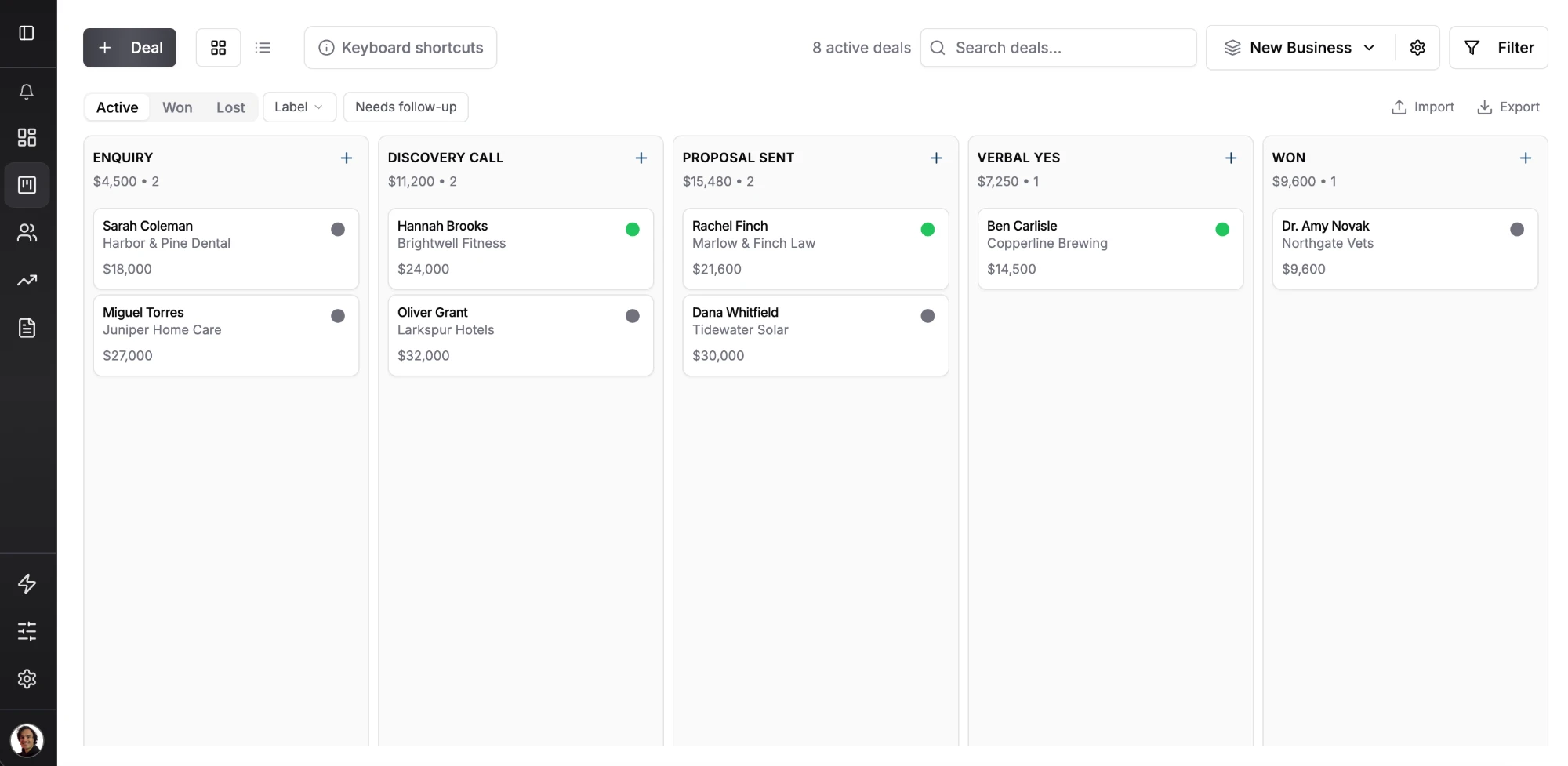
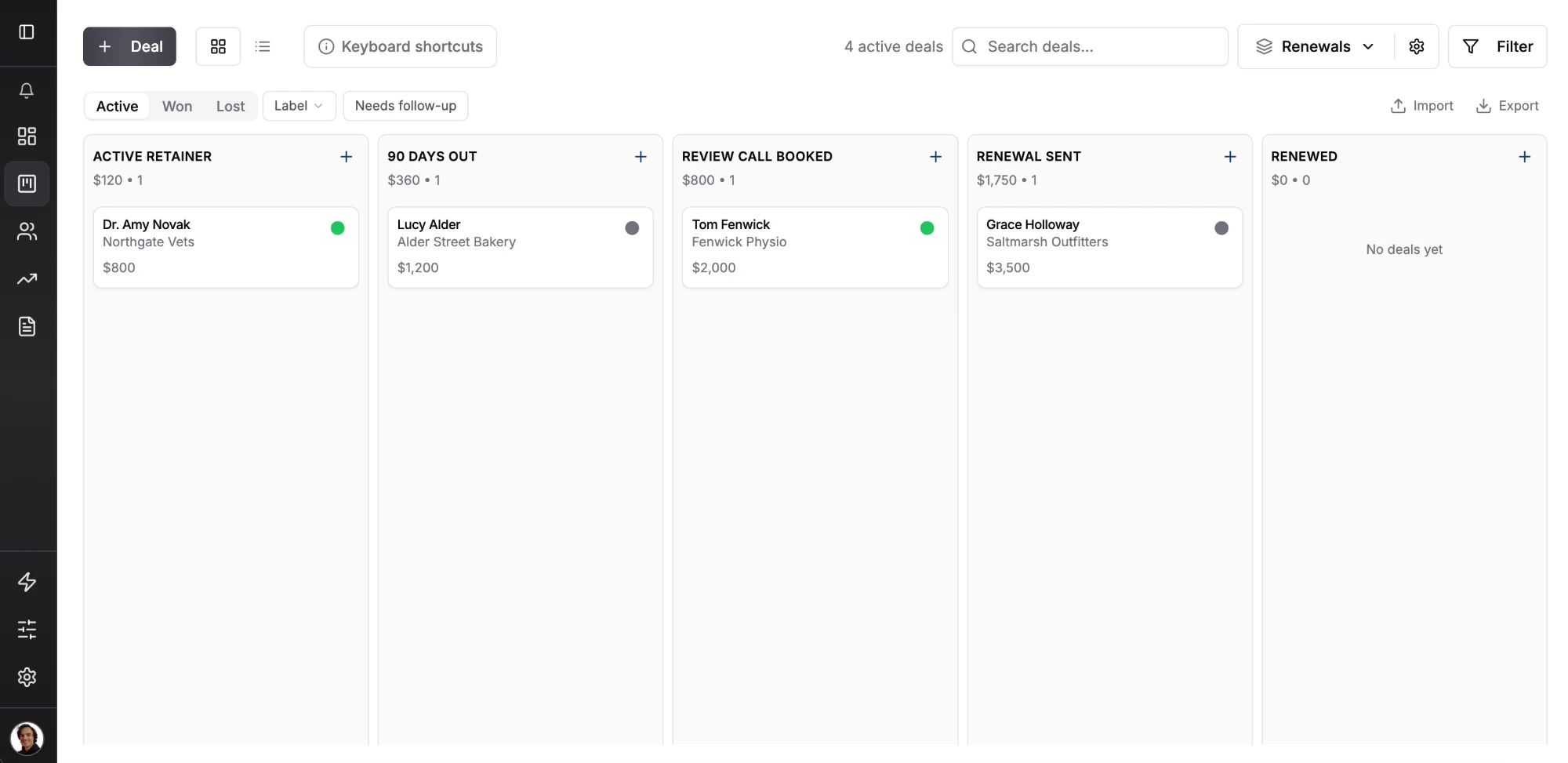
Most advice says to keep two pipelines and then stops. Here are the stages for both, and they work in any CRM on this list that has more than one pipeline.
| Pipeline | Stages | A deal moves forward when |
|---|---|---|
| New business | Enquiry, Discovery call, Proposal sent, Verbal yes, Won | The prospect does something, such as booking the call or saying yes |
| Renewals | Active retainer, 90 days out, Review call booked, Renewal sent, Renewed | The renewal date gets closer or the client replies |
Lost and Not renewed are outcomes with a reason, not stages. We go through the rule for each stage in our guide to the agency sales pipeline.
The pipeline from this post
Every pitch, and when to follow up
- Enquiry
- Discovery
- Proposal
- Verbal yes
- Won
Northgate SEO retainer
Set your stages up like this and add the pitches you have out. Each morning’s email tells you which ones need a follow-up.
7 days free, no card
“My agency has used many CRM’s and most of them are bloated and super complicated.”
a verified customer who runs an agency
What to record on a renewal deal
Put the monthly retainer in the deal value, so the pipeline total shows your recurring revenue. Add a label for the service and a custom field for the renewal date.
Then set the reminder for 90 days before the renewal date on the day the client signs. In Fluid CRM a deal has one reminder at a time and one contact, so the reminder goes on the renewal deal and the main contact is the person who signs.
What happens after the deal is won
A sales CRM’s job ends at the signature. When a deal reaches Won, create a deal for that client in the Renewals pipeline and pass four things to whoever delivers the work: the scope, the main contact, the start date and the renewal date.
monday CRM, Capsule’s project boards and Pipedrive’s project add-on can carry the client further in the same tool. With Fluid CRM the delivery happens in your project tool, and our client onboarding checklist covers what to send in the first week.
The other end of the pipeline needs the same care. If the board looks thin, start with these agency lead generation methods.
What 5 And 10 Seats Cost Over A Year
Monthly prices hide the real number, so here is a full year for a 5-person and a 10-person agency. Every row is on annual billing unless it says otherwise.
| CRM and plan | 5 seats, one year | 10 seats, one year |
|---|---|---|
| Fluid CRM, one plan | $720 | $1,440 |
| monday CRM, Basic | $720 | $1,440 |
| Pipedrive, Lite | $840 | $1,680 |
| Zoho CRM, Standard | $840 | $1,680 |
| GoHighLevel, Starter (3 client accounts) | $970 | $970 |
| HubSpot Sales Hub, Starter, billed monthly | $1,200 | $2,400 |
| Salesflare, Growth | $1,740 | $3,480 |
| Capsule, Growth | $2,160 | $4,320 |
| Pipedrive, Growth | $2,340 | $4,680 |
| GoHighLevel, Unlimited | $2,970 | $2,970 |
| HubSpot Sales Hub, Professional, with the required onboarding | $6,900 | $12,300 |
A flat price wins as headcount grows. GoHighLevel Starter is the lowest number in the 10-seat column, as long as 3 client accounts are enough.
Seat bundles change the maths for teams in between. A 7-person agency on monday CRM pays the 10-seat price.
Budget for the plan where email sync or automations start, not for the entry price. On Pipedrive that is Growth, and on HubSpot it is Professional with its onboarding fee. If you are choosing mainly by headcount, our guide to the best CRM for small agencies goes through it by team size.
FAQ
Fluid CRM is the best CRM for a marketing agency of 1 to 10 people that wants to track its own sales and its clients’ leads, at $16 per seat a month. HubSpot is the better choice when the agency also wants marketing automation. GoHighLevel is the better choice when every client needs their own account and login.
For a digital marketing agency that sells retainers, pick a CRM with a second pipeline for renewals and a reminder before each renewal date. Fluid CRM costs $80 a month for 5 seats and $160 for 10. Pipedrive Lite costs $120 and $240, and monday CRM Basic costs $90 and $180. On annual billing monday CRM Basic costs the same as Fluid CRM.
An advertising agency that manages lead campaigns for clients should pick a CRM with a separate pipeline per client, such as Fluid CRM, or GoHighLevel if clients need their own login. A digital agency that sells one-off projects rather than retainers should look at monday CRM, which keeps the sale and the delivery on one board. Fluid CRM has no marketing automation and no project management.
Pipedrive is better for a marketing agency that only needs to track its own new business, and HubSpot is better for one that also wants marketing automation. Pipedrive starts at $24 per seat a month and its email sync starts on Growth at $49. HubSpot Sales Hub starts at $20 per seat a month, and Professional is $100 per seat a month plus a required $1,500 onboarding fee.
Yes, with GoHighLevel, on its $497 a month plan. GoHighLevel is a CRM inside a wider marketing platform, and reselling it under your own brand needs SaaS Mode, which is on that plan and not on the $97 or $297 plans. Its branded client portal app is a $49 a month add-on per client account. Fluid CRM cannot be white-labeled and has no client portal.
Which CRM Should Your Marketing Agency Pick
Before Fluid CRM, I booked 1,250+ sales calls for B2B companies at my outbound agency. Again and again, I saw small businesses struggle with messy spreadsheets and slow, overly expensive CRMs.
So we built Fluid CRM for the part before a client signs: your own pitches and each client’s leads in one place, and a morning email that tells you who to follow up. One plan, $16 a seat a month, everything in it.
Omar Abdalla, founder of Fluid CRM
Start your free weekStart with the split from the top of this post. If you want client logins, your brand on the software or project delivery in one tool, pick GoHighLevel or monday CRM and skip the rest of the list.
If you want a simple place for your own new business, your renewals and your clients’ leads, Fluid CRM is built for agencies of 1 to 10 people. It is an agency CRM that takes seconds to update, with no portal, no white label and no project tools.
Start your 7-day free trial here, no credit card required.