
Creative agencies rarely lose work to a rival studio. They lose it in the weeks when everyone is busy making the last project and nobody touches the pipeline. Then the project ships and there is nothing booked behind it.
The best CRM for creative agencies depends on how you win work. Fluid CRM ($16 per seat a month) suits project-based teams of 1 to 10. Pipedrive suits studios with a full-time salesperson, HubSpot suits inbound content agencies, Productive and monday CRM add delivery and HoneyBook suits solo creatives.
Why Creative Agencies Run Out of Work Right After a Big Project
A branding studio or a video production company sells projects, and projects are lumpy. A rebrand fills six weeks and a three-day shoot fills two weeks of prep and edit. During those weeks the people who sell are also the people who make.
So the sales side stops. An inquiry from the portfolio site sits in the inbox, an estimate goes unanswered and nobody chases it because the edit is due Friday. When the project ends, the board is empty and the next month is quiet.
That is the feast-or-famine loop most creative owners know. It isn’t a discipline problem. It comes from a CRM that only works when someone has time to open it, and in production weeks nobody does.
Where creative work comes from
Most creative agencies win work in four ways:
- Past clients who come back for the next campaign, video or brand refresh
- Referrals from those clients, from other studios and from freelancers
- Inbound inquiries from the portfolio, a directory or a social post
- Pitches and bids, where you send a treatment, a deck or an estimate against other studios
Three of those four need someone to check back at the right moment. Which past client did you last hear from, and when did you last check in with them?
Before we built Fluid CRM, my outbound agency Fenixtal generated 12M€+ in pipeline for 50+ B2B clients. Around 10 of those clients were marketing agencies, and several more were designers and web designers. Almost none of them had a CRM they liked, so the leads I sent them often died in a messy spreadsheet or in a CRM nobody opened.
That is why this list is sorted by how a creative agency wins work and not by feature count. If you want the product page for teams like yours, start with our agency CRM.
The 6 Best CRMs for Creative Agencies, Compared
The six tools below fall into three kinds:
- Sales CRMs track the clients and projects you are trying to win
- Agency management tools hold the deal plus the budget, the time and the delivery
- Client booking tools send the proposal, the contract and the invoice for a solo creative
We go through the full sales CRM versus all-in-one argument in our list of the best CRMs for marketing agencies. This post stays on what changes when you sell creative projects.
| CRM and plan | Kind | Best for | 5 people, per month | Project or delivery tools |
|---|---|---|---|---|
| Fluid CRM, one plan at $16 per seat | Sales CRM | Project-based creative teams of 1 to 10 | $80 | No |
| Pipedrive, Lite at $24 per seat | Sales CRM | Sales-led studios of 3 to 20 | $120 | Paid add-on |
| HubSpot Sales Hub, Starter at $20 per seat | Sales CRM with marketing tools | Content agencies that sell inbound | $100 | Not included |
| monday CRM, Basic at $18 per seat | Sales plus work boards | Teams that want crew and sale on one board | $90 | Yes |
| Productive, Essential at $12 per seat | Agency management | Agencies of 10 or more tracking profit per project | $60 | Yes |
| HoneyBook, Premium at $109 for the whole team | Client booking | Solo creatives and two-person studios | $109 | Proposals, contracts and payments |
Every row is on monthly billing except HoneyBook, which shows its price billed yearly for unlimited team members.
1. Fluid CRM (best for creative teams of 1 to 10 that sell projects)
Fluid CRM opens on a visual pipeline, and a new project inquiry takes a few seconds to add. Each deal can hold a reminder date, and a daily digest email at 9 a.m. in your own time zone lists the follow-ups due that day, so a producer on set knows who to call without opening the app.
Verdict: Fluid CRM is a sales CRM for creative agencies of 1 to 10 people that need their new business to keep moving while the team is in production. It tracks who you are trying to win and when to follow up, and it stops at the signed estimate.
Price: $16 per seat a month or $144 per seat a year. One plan with every feature in it, and a 7-day free trial with no credit card required.
Best for: Branding, content and video teams of 1 to 10 that sell projects and lose track of estimates and past clients during busy weeks.
Not for: Agencies that want project management, invoicing, a client portal, two-way email sync or several contacts on one deal. Fluid CRM has none of those, and email is logged by BCC.
Cost for 5 seats: $80 a month, or $720 a year on annual billing.
What creative agencies like: Unlimited pipelines, so new projects and past clients each get their own board. Custom fields, labels, lead capture forms, 8 automations, an API with webhooks and a connector that lets Claude and ChatGPT find deals, add notes and set reminders. It works in the phone browser, and there is no mobile app.
Kyler Thompson of Knight Theory, a solo creative studio, explained why he picked it over the all-in-ones in his review: “I run a solo creative studio and have tried more CRMs than I care to admit… Other CRMs force so many unneeded features onto me in the name of being an all-in-one, so I love that FluidCRM is exactly what I needed.”
Andy, a freelance web designer, noticed the design first: “It also looks visually fantastic which I appreciate as a web designer who can be overcritical of website design.”
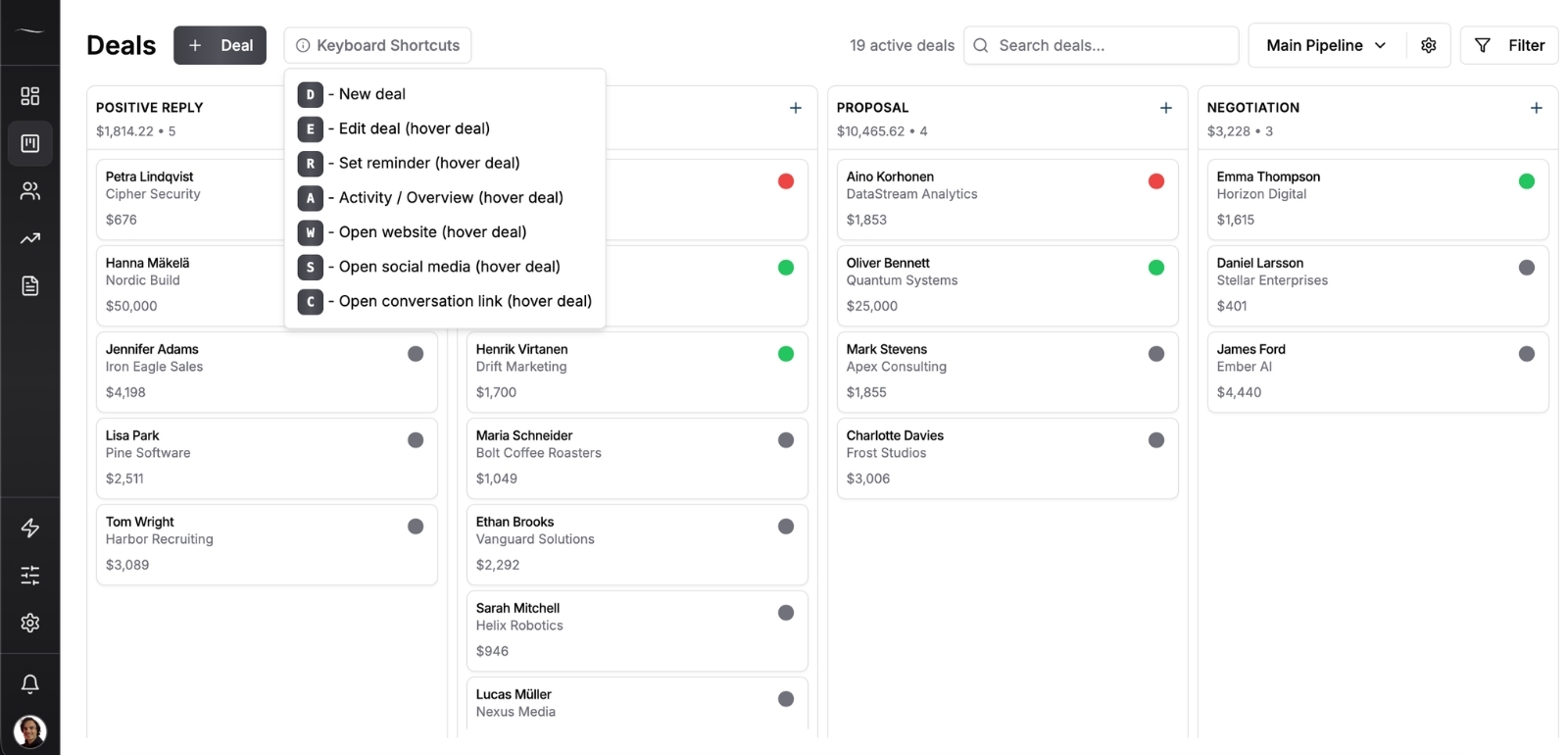
Where it falls short: A deal holds one reminder at a time and reminders sit on deals, not contacts. There is no file storage on a contact either. If your producer needs to see crew, budget and the sale in one place, look at monday CRM or Productive below.
2. Pipedrive (best for sales-led studios that want email sync)
Pipedrive is built around a drag-and-drop pipeline, and it suits a studio with one or two people whose job is mostly selling. It has a large app marketplace and a projects add-on for the handoff after the sale.
Verdict: Pipedrive is the pick for a creative agency with a dedicated new business person who works mostly in email. Two-way email sync and automations start on Growth, not on the entry plan.
Price: Lite $14, Growth $39, Premium $59 and Ultimate $79 per seat a month billed annually, or $24, $49, $79 and $99 billed monthly. There is no free plan and the trial is 14 days.
Best for team size: 3 to 20 people.
What creative agencies like: Unlimited pipelines on every plan, a clean board and plenty of integrations. Premium and Ultimate include the projects tool.
Where it falls short: A studio that wants email sync needs Growth, which is $245 a month for 5 seats on monthly billing.
3. HubSpot Sales Hub (best for content agencies that sell inbound)
HubSpot puts the sales pipeline and the marketing tools on one contact database. That matters for a content agency whose own new business comes from blog posts, newsletters and webinars.
Verdict: HubSpot is the pick for a content agency that sells inbound and wants its own marketing and its pipeline in one system. The features most teams upgrade for sit on Professional, which needs a one-time $1,500 onboarding fee.
Price: Free for up to 2 users. Starter is $20 per seat a month. Professional is $90 per seat a month on annual billing or $100 monthly, plus a required one-time onboarding fee of $1,500. Enterprise is $150 per seat a month with a one-time onboarding fee of $3,500.
Best for team size: 10 or more, or any size if your clients use HubSpot too.
What creative agencies like: One record for marketing and sales, a free plan to start on and strong reporting.
Where it falls short: The step from Starter to Professional more than quadruples the seat price. Most 3-person branding studios use a small part of it, which is why we wrote about whether HubSpot is too complicated for small teams.
4. monday CRM (best when crew, budgets and the sale share one board)
monday CRM sits on top of monday’s work boards. A won video project can become a production board with shoot dates, crew and deliverables in the same tool.
Verdict: monday CRM is the pick for a production company or content agency that wants the sale and the production schedule in one place.
Price: Basic $18, Standard $25 and Pro $41 per seat a month, or $12, $17 and $28 billed annually. Plans start at 3 seats and the trial is 14 days.
Best for team size: 3 people or more.
What creative agencies like: Boards a producer can shape around a shoot, and quotes and invoices included from Basic, with 20 a month on that plan.
Where it falls short: Basic allows 5 columns per board and 1,000 active contacts and deals. A good production board also needs someone to own its setup.
5. Productive (best for agencies of 10 or more that track profit per project)
Productive is agency management software with a sales pipeline inside it. Deals come with a probability and an expected close date, proposals export to PDF and a won deal turns into a budget the team tracks time against.
Verdict: Productive is the pick for a creative agency of 10 or more that needs to know whether each project made money. It is more software than a 4-person studio needs.
Price: Essential $10 and Professional $25 per seat a month billed yearly, or $12 and $29 billed monthly. Ultimate is a custom quote. All plans need at least 3 seats, and the trial is 14 days with no credit card.
Best for team size: 10 people or more, with someone who owns operations.
What creative agencies like: Budgeting, resource planning, time tracking and reporting in one tool, and clients can be invited at no extra cost.
Where it falls short: Essential has 1 sales pipeline and Professional has 3. Every freelancer who tracks time needs a paid seat.
6. HoneyBook (best for solo creatives who send proposals, contracts and invoices)
HoneyBook is client management for solo creatives. An inquiry comes in through a lead form, and the proposal, the contract and the invoice go out from the same project.
Verdict: HoneyBook is the pick for a one-person studio, photographer or videographer whose pain is paperwork and payments, not a list of deals to chase. It is available to businesses in the US, Canada, the UK and Australia.
Price: Starter $29, Essentials $49 and Premium $109 a month billed yearly. Essentials allows up to 2 team members and Premium has no limit. The trial is 30 days with no credit card.
Best for team size: 1 or 2 people.
What creative agencies like: Proposals clients can sign and pay from one file, a client portal and a customizable project pipeline.
Where it falls short: It is built around booked projects more than a list of prospects, and card payments carry processing fees. Dubsado and Bonsai are the same kind of tool, built around contracts, invoices and client paperwork.
What this list leaves out
Workamajig, Scoro and Accelo are agency management suites with sales built in, much like Productive, and they suit larger shops. Design and web studios have their own list in the best CRMs for web designers. If you are choosing mainly by headcount, the CRM for small agencies guide goes by team size.
Which CRM Fits How Your Agency Wins Work
Creative agencies win work in four main ways, and each one points to a different pick on this list.
Pitches, treatments and bids
Production companies and branding agencies that pitch against other studios need a stage for the pitch and a date on every bid. Fluid CRM handles that with a “Treatment or bid sent” stage and a reminder on each one. Move to Productive once you need to price crew time and track the budget after the award.
Count your pitch win rate every quarter, which is pitches won divided by pitches sent. Our closing ratio calculator does the sum, and a low number tells you to pitch less and follow up more.
Past clients and referrals
If most of your work comes back from people you already worked with, the CRM has to remind you to call them. That is a reminder on a deal, which Fluid CRM and Pipedrive both do.
Inbound inquiries from your portfolio
Content agencies and studios with a strong portfolio get inquiries through the website. Pick a CRM with a built-in lead form so each inquiry lands as a deal. Most tools on this list have one, including Fluid CRM, HubSpot and HoneyBook. Our guide to lead tracking software covers what to record on each inquiry.
A one-person creative studio
If contracts and getting paid are the pain, pick HoneyBook. If the pain is forgetting to follow up on estimates and past clients, pick Fluid CRM at $16 a month for one seat.
How To Keep New Work Coming In During Production Weeks
Here is the setup we suggest to creative teams in Fluid CRM, and most of it works in any CRM on this list. Its whole job is to keep sales moving when nobody has time to open the app.
Give every open deal a date
An estimate with no reminder is the deal most likely to die during a shoot, because the person who sent it is now on set. Set the reminder the moment the estimate or treatment goes out, and never leave a deal in a stage without one.
Add the stages only production work needs
Keep the stage list short. A production company adds “Treatment or bid sent” and counts a deal as won at “Awarded”, when the deposit or purchase order arrives, because a verbal yes on a shoot can still move or vanish. The rule for every other stage is in our guide to the agency sales pipeline.
Record the three fields creative work needs
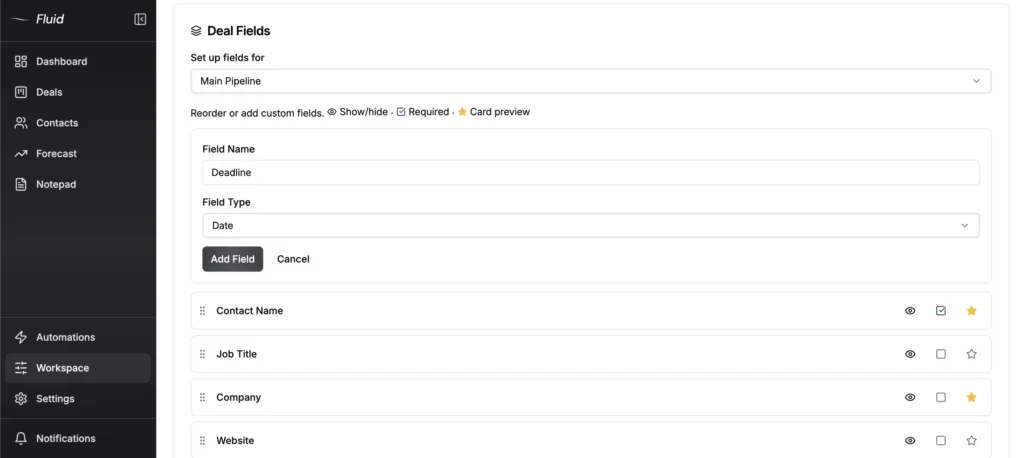
Add a label for the project type, such as brand identity, video or content. Add a number field for the budget and a date field for the launch or shoot date, so you can see which projects are about to free up the team.
Keep a pipeline for past clients
Make one deal per finished client and, on delivery day, set its reminder for a few months out. When it fires, send the finished reel, the case study or an idea for their next campaign. We walk through the stages for this in our post on how to keep in touch with clients.
Put a form on the portfolio site
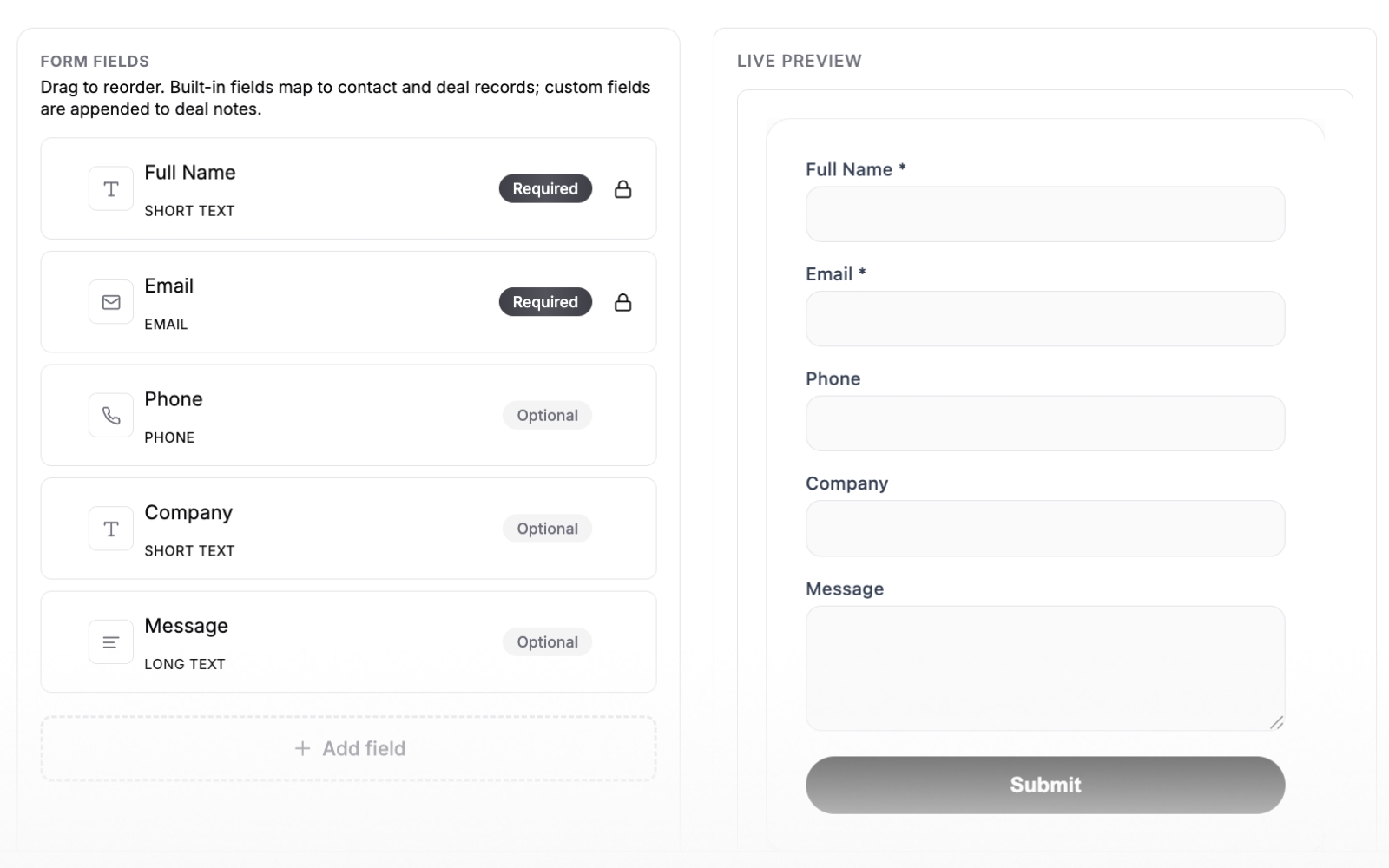
Embed a lead capture form on the contact page so every inquiry becomes a contact and a deal in the right pipeline. Kyler asked for embeddable forms during his trial, and they shipped the same day.
Let the digest and your AI assistant do the logging
The daily digest email lists what is due, so the team does not have to open the app on a shoot day. With the connector set up, a producer can tell Claude or ChatGPT to add a note to a deal or set next Tuesday’s reminder in one sentence.
When a Creative Agency Should Skip Fluid CRM
Some creative agencies want a CRM that is really a project tool. Anton Salmi, who does project-based work, asked in his review for the “possibility change Deals name into Projects” and for attachments on individual contacts. If that is what you want, Fluid CRM is the wrong pick and we would rather say so now.
Pick Productive or monday CRM if you need budgets, resourcing, time tracking and invoices next to the sale. Pick HoneyBook if contracts and payments are the daily work.
Stay on Google Sheets if you are one person with fewer than about ten open projects. It stops working the week a second person edits it or a follow-up date matters, because Google Sheets never reminds you of anything. If you are unsure the switch pays off, our guide to CRM ROI shows how many recovered projects cover a year.
FAQ
For a creative agency of 1 to 10 people that sells projects, Fluid CRM at $16 per seat a month is the simplest fit. Pipedrive suits a studio with a dedicated salesperson who wants email sync. Productive and monday CRM suit agencies that want delivery in the same tool, and HoneyBook suits solo creatives.
Most small creative agencies do not. A sales CRM only has to keep track of who you are trying to win and when to follow up, and the delivery can live in the project tool you already use. Pick an all-in-one such as Productive or monday CRM only if you need budgets and crew time tied to each sale.
A small video production company does well with a sales CRM such as Fluid CRM or Pipedrive for bids and a separate tool for production. A larger one may want monday CRM or Productive so the bid, the budget and the shoot schedule share one place. A solo videographer may prefer HoneyBook for contracts and payments.
On monthly billing, 5 seats cost $80 a month on Fluid CRM, $90 on monday CRM Basic, $100 on HubSpot Starter and $120 on Pipedrive Lite. Productive Essential costs $60 a month for 5 seats. HoneyBook Premium is $109 a month billed yearly for any team size.
Yes. Add a stage for the pitch or bid, give each one a reminder date and mark it won when the deposit or purchase order arrives. Count pitches won against pitches sent every quarter to see whether you are pitching too much.
Pick the CRM That Keeps Working in Your Busiest Weeks
The best CRM for creative agencies is the one that still gets updated during a shoot week or a launch. If that means a simple board with a reminder on every deal and a past-clients pipeline, Fluid CRM is an agency CRM built for teams of 1 to 10.
Start your 7-day free trial here, no credit card required.