

Attio is a good CRM, which is an odd way to open a post about leaving it. The problem is rarely quality. Either it asks for more building than a small team has time for, or the thing you now need sits on a plan above the one you bought.
The best Attio alternative depends on why you are leaving. If Attio asks too much of you, pick Fluid CRM, Pipedrive or Capsule, and if it does too little, pick folk, Close, Clarify or HubSpot. If you use custom objects every week, stay on Attio.
| Why you are leaving Attio | Look at |
|---|---|
| Daily tasks take too long | Fluid CRM, Pipedrive |
| Nobody wants to own the setup | Fluid CRM, Capsule |
| You sell through relationships and LinkedIn | folk |
| Your team lives on the phone | Close |
| You want the notes and updates written for you | Clarify |
| You need marketing and service in the same tool | HubSpot |
Here are all seven side by side. The setup column is my own read of each tool.
| Tool | Best for | What it charges for | Setup effort | Price per seat, annual / monthly | Main trade-off |
|---|---|---|---|---|---|
| Fluid CRM | Small teams that want deals moving in the first hour | Seats only, one plan | Low | $12 ($144 a year) / $16 | No two-way email sync and no custom objects |
| Pipedrive | A structured sales process | Seats, plus add-ons billed per company | Medium | Lite $14 / $24, Growth $39 / $49 | The add-ons sit outside the seat price |
| Capsule | Consultancies that think in contacts | Seats, with a contact ceiling per plan | Low | Starter $18, Growth $36, both annual | More than one pipeline starts at Growth |
| folk | Relationship-led selling | Seats, with deals on the higher plan | Low | Standard $24 / $30, Premium $48 annual | Custom objects, deals and API access need Premium |
| Close | Teams that call all day | Seats, plus calling usage and AI credits | Low | Essentials $35 / $49, Growth $99 / $109 | Workflows and the power dialer need Growth |
| Clarify | Meeting-heavy teams | Credits, with unlimited seats | Low | From $40 a month annual for 5,000 credits | The credit tiers are labelled by headcount |
| HubSpot | Sales, marketing and service together | Seats, plus a one-time onboarding fee | High | Professional $90 / $100 | $1,500 onboarding fee on Professional |
Why Small Teams Leave Attio
Before you compare anything, answer one question. Is Attio asking too much of you, or doing too little for you? Those are opposite problems, and mixing them sends you to the wrong tool.
For small teams I think it is nearly always the first one, for three reasons.
The daily tasks are slow
Matthew is a verified customer who was on Less Annoying CRM for years and then on Attio. His verdict is the fairest one I have read.
“Attio is great, but 10-second tasks take 5 minutes.”
That sounds like a small complaint and it is the expensive one. A CRM that is slow to use gets opened less, and leads die on the days it stays closed.
Someone has to build it
Attio is a data model you design. You decide the objects, the attributes and the workflows, and that freedom is what you are paying for.
It also means somebody on the team has to own that job. In a 4-person company that somebody is usually the founder, on a Sunday.
I saw where that ends at Fenixtal, my outbound agency, which booked 1,250+ sales calls for 50+ B2B clients. The clients who lost those leads rarely had a bad CRM. They had one that was more than they needed, so nobody used it.
When did you last change something in Attio’s setup because a deal needed it, not because the tool did?
The plan has ceilings you meet before the seat count
Attio’s free plan covers 3 seats, which sounds generous. It also stops at 200 emails a month, 250 workspace credits and 3 reports. Plus stops at 10 seats, 5 objects and 15 reports.
None of that is hidden, it is all on Attio’s pricing page. I went through the full bill in Attio pricing, so I will not repeat it here.
When I studied 1,258 negative CRM reviews across 13 products, 45 of them were about Attio. The top complaints across the whole set were workflow limits, support and clutter, not price.
Attio Alternatives If Attio Asks Too Much Of You
The three tools in this group do less than Attio on purpose. You give up the custom data model and get a pipeline that works the day you sign up.
1. Fluid CRM, best for small teams that want deals moving in the first hour
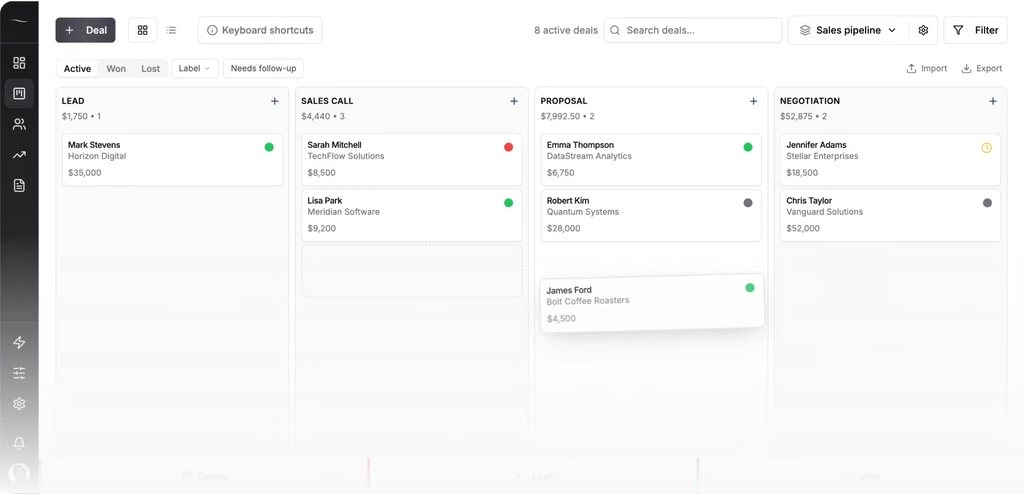
Fluid CRM is a sales pipeline for small B2B teams. You get a board of deals, reminders, lead capture forms, 8 in-app automations and an API with webhooks.
It charges for seats and nothing else. There is one plan at $16/seat/month or $144/seat/year, with every feature in it.
Matthew’s line about his first hours is the reason it sits first in this group.
“My onboarding and first hours have been easy.”
A second verified customer coordinates a European coaching network and moved 6 pipelines and roughly 190 deals across from Attio. He runs 7 pipelines now, most of them nothing to do with sales.
“I run seven pipelines… and the board view keeps each one clean and manageable.”
Fluid CRM also connects to Claude, ChatGPT, Gemini and Perplexity through MCP, so your AI assistant can read and update the pipeline. Attio has that on every plan too, so treat it as the basics and not as a reason to switch.
Here is what you give up coming from Attio. Email gets into Fluid CRM by BCC, where Attio syncs your inbox and calendar on every plan, and there are no custom objects.
Pick it if you want to see what needs doing today without building anything first.
2. Pipedrive, best for a structured sales process
Pipedrive is built around one idea, a visual pipeline where every deal has a next activity. It is the closest thing to a default choice in this category.
It charges for seats on four plans, then sells add-ons such as LeadBooster and Smart Docs that are billed per company. Lite is $14 a seat on annual billing and $24 monthly, and Growth is $39 and $49.
Setup takes longer than the two tools around it because there are more settings to meet. Full email sync starts at Growth, so that is the plan to compare against Attio.
Pick it if you have a repeatable sales process and want the tool to enforce it. I compared the two directly in Attio vs Pipedrive, and there is a wider list in Pipedrive alternatives.
3. Capsule, best for consultancies that think in contacts
Capsule is a contact manager first and a sales tool second. That order suits consultancies and service firms where the relationship outlasts any single deal.
It charges for seats, and each plan carries a contact ceiling. Starter is $18 a seat on annual billing with 30,000 contacts, and Growth is $36.
The trade-off is that workflow automation and more than one pipeline start at Growth. The free plan covers 2 users and 250 contacts, so a team of 3 cannot use it.
Pick it if you want something calm and conventional that your whole team understands in a morning.
Attio Alternatives If Attio Does Too Little
Fewer people leave Attio because it does too little. They like Attio fine and have hit something it does not do on their plan, such as sequences and call intelligence, which sit on Pro at $79 a seat on annual billing.
4. folk, best for relationship-led selling
folk is the closest thing to Attio in look and feel. It is built for people who sell through their network, with a LinkedIn extension that captures contacts as you browse.
It charges for seats. Standard is $24 a member on annual billing and $30 monthly, and it includes email, calendar and WhatsApp sync plus contact enrichment.
Standard includes pipeline management. Custom objects and deals, email sequences, dashboards and API access are on Premium at $48 a member on annual billing.
Pick it if your pipeline is really a list of people you keep in touch with. I put it next to Fluid CRM in Fluid CRM vs folk.
5. Close, best for teams that call all day
Close is a CRM with the phone built in. Calling, SMS and email all happen inside the lead record, so nothing has to be logged afterwards.
It charges for seats, then passes calling and SMS usage through at cost and includes a monthly allowance of AI credits. Essentials is $35 a user on annual billing and $49 monthly.
Automated workflows and the power dialer need Growth at $99 and $109. If outbound calling is the job, that is the real starting plan.
Pick it if your reps spend their day dialling and you are tired of joining three tools together to let them.
6. Clarify, best if you want the record written for you
Clarify records the meeting, writes the summary and updates the deal. It is aimed at teams whose week is mostly calls.
It charges for credits and gives you unlimited seats. The free plan has 1,000 credits a month, and Starter begins at $40 a month on annual billing for 5,000.
Clarify’s own pricing page labels that 5,000-credit tier as “Great for teams up to 3 people”, so headcount still shapes the bill through a different unit.
Pick it if most of your team only needs to look things up and a few people run all the meetings. The full comparison is in Attio vs Clarify.
7. HubSpot, best when you need marketing and service too
HubSpot is a platform, with sales, marketing, service and content tools sharing one database. It is the answer when a CRM alone is no longer the question.
It charges for seats and a one-time onboarding fee on Professional. The free tools cover 2 users and Starter lists at $20 a seat a month. Sales Hub Professional is the plan most teams leaving Attio would compare, at $90 a seat on annual billing or $100 monthly, plus a required $1,500 onboarding fee.
Setup is the heaviest on this list, and most teams end up with someone whose job includes running it.
Pick it if you have a marketing team that needs the same data your salespeople use.
Attio alternatives I left off, and why
- Twenty is open source and built around a custom data model, so it asks for more setup than Attio and suits teams with a developer.
- Salesflare fills the CRM from your inbox, which Attio’s own email sync already covers for most people.
- Affinity is built for investment firms and starts at $2,000 a user a year. I covered it in Affinity vs Attio.
- Copper only makes sense inside Google Workspace, and it is in Copper CRM alternatives.
- Zoho CRM offers breadth with real setup time, covered in Zoho CRM alternatives.
When You Should Stay On Attio
Switching CRMs costs time you will not get back, so it is worth checking that you should. Stay on Attio if any of these describe you.
You use custom objects every week
If your business does not fit contacts, companies and deals, Attio’s data model is the reason you bought it. None of the simpler tools above will replace that.
Someone on your team enjoys owning the setup
Some people like building workflows, and a CRM with a keen owner works well. If you have that person, the build burden is not a burden.
You fit inside your plan’s limits
A team of 3 that sends under 200 emails a month through Attio gets email sync, enrichment and an MCP server for nothing. That is hard to beat.
Your sales process keeps changing
If you are still working out how you sell, a tool that bends is worth more than one that is quick. Come back to this list when the process settles.
How To Move Your Data Out Of Attio
Moving a small team takes an afternoon if you resist the urge to bring everything.
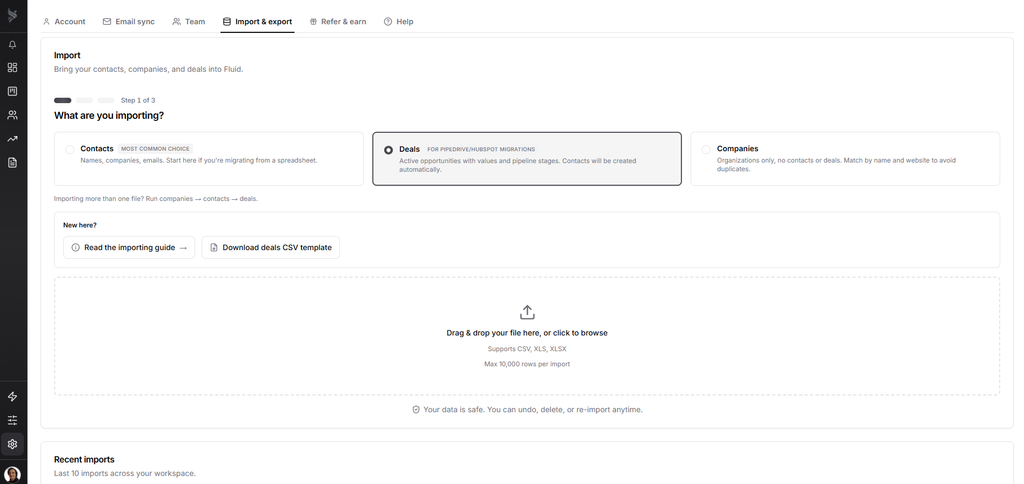
Step 1. Export each list as a CSV
Export companies, people and deals from Attio as CSV files. Keep the company name on every deal row so you can match deals to companies later.
Step 2. Decide what not to bring
This is the step that saves you. Leave behind attributes nobody filled in, lists nobody opened this quarter and deals that have been dead for a year.
Step 3. Map the fields that matter
Deal name, value, stage, owner, next step and the linked company and contact are enough for most teams. Custom attributes can come across as custom fields if you still use them.
Step 4. Import and check ten records by hand
Import the files, then open ten deals and compare them with Attio. The Fluid CRM version of this is in how to import your contacts and deals.
Step 5. Run both for a week before you cancel
Workflows and reports do not travel in a CSV, so you will find something you forgot. A week of overlap is cheaper than a lost deal.
Attio Alternatives FAQ
For a team under 10 that mainly needs a clear pipeline and reminders, Fluid CRM or Pipedrive are the closest fit. If the team sells through relationships, folk is the better match. The right answer depends on whether Attio felt like too much work or too little help.
Small teams mostly switch because everyday tasks take too long and somebody has to design and maintain the setup. Larger teams switch when they meet a plan limit, such as the 10-seat ceiling on Plus, or need calling or marketing tools Attio does not centre on.
Fluid CRM and Capsule are the simplest on this list. Both give you a working pipeline without designing a data model first. Fluid CRM has one plan with every feature in it, and Capsule keeps most of its automation on the Growth plan.
HubSpot’s free tools cover 2 users, Capsule’s free plan covers 2 users and 250 contacts, and Clarify’s free plan includes 1,000 credits a month. Attio’s own free plan covers 3 seats, so check whether you have really outgrown it. Fluid CRM has no free plan, only a 7-day free trial.
Twenty is the best-known open-source CRM with a similar custom data model, and you can host it yourself. Expect more setup than Attio, not less. It suits teams with a developer who wants control over the system.
folk is easier to start with and stronger for LinkedIn-led selling. Attio is more flexible and includes more on its free plan. folk keeps custom objects, deals and API access on its Premium plan, so compare that plan if you need them.
Yes, you can export records from Attio as CSV files and import them elsewhere. Contacts, companies and deals move without much trouble. Workflows and reports have to be rebuilt in the new tool.
Which Attio Alternative Should You Pick
If Attio asks too much of you, pick the tool that does less and gets opened more, which means Fluid CRM, Pipedrive or Capsule. If it does too little, pick by the gap, with folk for relationships, Close for calling, Clarify for meetings and HubSpot for marketing.
And if you read the stay section and nodded, keep Attio. If what you want is a pipeline your team opens every morning with nothing to build first, that is what Fluid CRM is for.
Start your 7-day free trial here, no credit card required.