

The client signed on Friday. By Wednesday they are asking about the extra landing page they were told was included, and nobody on your delivery side has heard of it.
A client onboarding checklist is a numbered list of steps that takes a new client from signed deal to first result, with an owner and a day on each. Start it when the deal is marked won. Fluid CRM keeps the sales notes and promises in one place, and the checklist goes in your delivery tool.
What a Client Onboarding Checklist Is and When It Starts
A client onboarding checklist is the same list of steps for every new client, in the same order, with one named person on each step. It covers the first 30 days, from the signed deal to the first check-in call.
Most checklists start at “contract signed” and go straight to the welcome email. That skips the step where the person who sold the work tells the people who will do the work what was agreed.
So this one starts a step earlier, at the moment the deal is marked won in your sales pipeline. If your stages before that point are still fuzzy, sort those first with my guide to sales pipeline stages.
Why Client Onboarding Breaks at the Sales Handoff
A sales conversation is full of small promises, and most of them never reach the contract. The contract says “monthly reporting”, and on the call the client heard something more specific.
Here are three examples of the kind of thing that gets said.
- “We can have the first campaign live before your trade show.”
- “Yes, you’ll get a short update every Friday.”
- “Your marketing manager can message me directly and won’t go through a ticket system.”
None of those is unreasonable, and each one is now part of what the client thinks they bought. If the delivery lead learns about them in week three, the client’s first month is spent correcting you.
Try this now. Can you name three things your newest client was told on a sales call that are not in their contract?
If you can’t, it is because nobody gave the seller a place to write those things down or a moment when they had to.
For a small agency that place is the deal itself. The notes from every call already sit on the deal in your agency CRM, so the handoff note belongs there too, next to the history it sums up.
The Sales Handoff Note: 7 Things That Must Travel With the Deal
The handoff note is a short summary the seller writes for the person who will look after the client. It takes about ten minutes, and it is the first step of the checklist below.
Copy these seven lines and fill them in for every won deal.
- The goal, in the client’s words. What they said they want to be different in three months, written the way they said it.
- What was sold and what was not. The package, the price, the start date and anything the client asked for that you said no to.
- Promises outside the contract. Every “yes, we can do that” from a call or an email, with the date it was said.
- The people. Who signed, who you will work with day to day and who approves the work.
- Dates the client mentioned. A launch, a trade show, a board meeting or a budget deadline.
- Worries and risks. What they were nervous about, what went wrong with their last supplier and anything that felt off.
- How they like to be contacted. Email, chat or phone, and how fast they expect a reply.
Line 3 is the one no contract covers, so give it the most care. Write each promise as its own sentence, because a delivery lead can tick off a sentence and can’t tick off a paragraph.
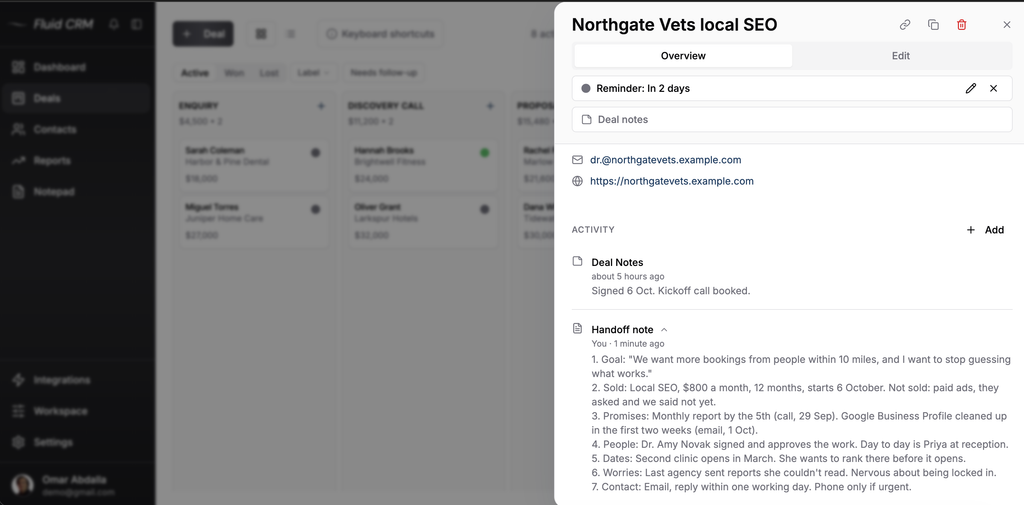
Make the note a rule before a deal is marked won
Agree as a team that no deal moves to won until its handoff note is written. It is a rule between people, and whoever owns the pipeline checks it once a week. The rules for the earlier stages are in my post on the agency sales pipeline.
The Client Onboarding Checklist: 24 Steps, Day by Day
The checklist has four phases and 24 steps. Each step names an owner and a day, counted from the day the deal was won.
It uses four roles. The seller closed the deal, the account lead owns the client relationship, the delivery lead owns the work and finance is whoever sends your invoices.
Before kickoff (days 0 to 3)
- Write the handoff note, then mark the deal won. Seller, day 0.
- Save the signed agreement where the delivery team can open it. Seller, day 0.
- Send the first invoice or set up billing. Finance, day 1.
- Name the account lead and tell the client who it is. Seller, day 1.
- Hold a 20-minute handoff call and read the note together. Seller, with the account lead and delivery lead, day 1.
- Send the welcome email with the kickoff date, the first weekly update and the 30-day check-in. Account lead, day 1.
- Send the intake questions and the list of logins and files you need, and ask for them back before the kickoff call. Account lead, day 2.
- Create the client’s project in your delivery tool from your template. Delivery lead, day 2.
- Send the kickoff agenda. Account lead, day 3.
The kickoff call (days 3 to 7)
Steps 10 to 14 all happen on the kickoff call itself, which the account lead books for a day between day 3 and day 7.
- Read the goal and the promises back to the client and correct them together. Account lead, kickoff day.
- Confirm what is included and what is not. Delivery lead, kickoff day.
- Agree the first visible result and its date. Delivery lead, kickoff day.
- Agree one or two numbers that will show the work is paying off. Account lead, kickoff day.
- Agree the channel, the weekly update day and who approves work. Account lead, kickoff day.
- Send a written recap the day after the call. Account lead, kickoff day plus one.
Step 10 is the reason the handoff note is worth ten minutes. The client hears their own words from someone who was not on the sales calls, and any promise that was misheard gets fixed in the first week.
The first week of work (days 7 to 14)
- Chase any missing logins, files or answers. Account lead, day 7.
- Share the plan for the first month with dates. Delivery lead, day 8.
- Send the first weekly update on the agreed day. Account lead, day 10.
- Send the client a short note asking how the first week went. Seller, day 10.
- Deliver the first visible result. Delivery lead, day 14.
An audit, a first draft or a live tracking dashboard all count as a first visible result, as long as the client can open it.
The first month (days 14 to 30)
- Ask for feedback on the first result and save it in writing. Account lead, day 16.
- Keep sending the weekly update on the same day each week. Account lead, day 17 and again on day 24.
- Go through the promise list line by line. Account lead, with the seller, day 25.
- Hold the 30-day check-in call. Account lead, day 30.
In step 23, every promise from line 3 of the handoff note gets one of three marks, which are done, dated or openly changed with the client. On the 30-day call, ask what has worked, what hasn’t and what they expected by now that they haven’t seen. The check-ins should not stop there, and my guide on how to keep in touch with clients covers what comes after.
The checklist at a glance
| Phase | Days | Steps | Main owner | Done when |
|---|---|---|---|---|
| Before kickoff | 0 to 3 | 1 to 9 | Seller, then account lead | The client has the kickoff date and agenda, and the delivery lead has read the handoff note |
| Kickoff call | 3 to 7 | 10 to 15 | Account lead | The client has the written recap |
| First week of work | 7 to 14 | 16 to 20 | Delivery lead | The client has seen a first result |
| First month | 14 to 30 | 21 to 24 | Account lead | The 30-day call is held and every promise is marked |
Where the CRM Stops and the Delivery Tool Starts
A checklist with 24 steps, owners and due dates is a small project, and a project belongs in a project tool. Keep it in whatever your team already uses to deliver work, whether that is a task board, a shared doc or a client portal.
Fluid CRM is a sales pipeline, and that is all it is. It can’t hold this checklist, because a deal has one reminder at a time and no tasks or sub-steps.
It also has no client portal, no file attachments, no proposals and no invoicing, and a deal holds one contact. A G2 reviewer in marketing and advertising put it this way. “I do wish the app focused on the entire client cycle (post-sales communications), but that is not what it is intended or marketed for.”
A sales CRM still does three things for onboarding.
- The history is already there. Every note you wrote and every email you BCC’d during the sale stays on the deal, so the delivery lead can read what was said.
- The handoff note has a place. Save it as a note on the deal, or add custom fields for the lines you want to see at a glance.
- A won deal can start the project. A won deal can send a webhook, which a tool like Zapier or Make can use to start the project in your delivery tool. I cover the basics in CRM with API.
Some small teams have no delivery tool yet. In that case, create a separate Onboarding pipeline with four stages named after the four phases above. It shows which client is in which phase and does not replace the checklist.
OpaPopa, a verified customer who coordinates a European coaching network of about 80 coaches, keeps seven pipelines in Fluid CRM and moves people between them. “Cross-pipeline automations (moving a deal from one pipeline to another when it hits a certain stage, carrying over all history) work exactly as you would expect.”
If you are still choosing a pipeline tool, I compared the options in best CRM for small agencies and in best CRMs for marketing agencies.
How to Adapt the Checklist for a Team of One to Three
In a team of one, you are the seller, the account lead, the delivery lead and finance. The roles merge and most of the steps stay.
Steps 4 and 5 go, because there is nobody to introduce and nobody to hand over to. Step 19 merges into step 18, since the weekly update already comes from the person who sold the work.
Keep the handoff note even when you are handing over to yourself. Three weeks after the last sales call you will be busy with the work, and you won’t remember the exact words you used about turnaround times.
In a team of two or three, the split is usually one person who sells and one or two who deliver. Keep all 24 steps, and let the seller stay as account lead until the kickoff recap is sent.
At Fenixtal, my outbound agency, we built 12M€+ in pipeline for 50+ B2B clients. My view is that the first month goes well when the client never has to repeat something they already told you.
FAQ
A client onboarding checklist should include a sales handoff note, the signed agreement and first invoice, a welcome email, intake questions, a kickoff call, a written recap, weekly updates, a first visible result within two weeks and a 30-day check-in. Every step needs one named owner and a day.
For a small agency or service business, client onboarding takes about 30 days. The kickoff call happens in the first week, the first visible result arrives by day 14 and a check-in call closes the month.
One person should own it from start to finish, and in a small agency that is usually the account lead. The seller owns the handoff note and the first three days, and the delivery lead owns the plan and the first result. In a one-person business the owner holds every role.
Start the Checklist the Day the Deal Is Won
Copy the seven-line handoff note today and fill it in for the last deal you won. If that takes more than ten minutes, the sale was never written down, and that is the thing to fix first.
Then put the 24 steps into the tool your team already delivers in, with a real name on each one. Your agency CRM only has to do one job here, which is keeping every note and promise from the sale on the deal until someone picks it up.
We built Fluid CRM to be that pipeline, with one plan at $16 per seat a month or $144 per seat a year.
Start your 7-day free trial here, no credit card required.