

A demo request lands at 2:10 on a Tuesday while the one person who would answer it is on a client call. Nobody else knows it arrived, and by 4:00 the buyer has booked a call with a competitor who picked up the phone.
Speed to lead is the time between a lead asking for something and a real person on your team answering. For a small B2B team, aim for 5 minutes on demo and quote requests during business hours, with one named owner and a fallback. Fluid CRM turns each form lead into a deal on your board.
What Speed to Lead Means for a Small Team
The clock starts when the lead hits submit, sends the email or leaves the voicemail. It does not start when someone on your team notices, and that gap is where most small teams lose the time without ever seeing it.
The clock stops when a human answers the actual question. An auto-reply that says “thanks, we’ll be in touch” tells the buyer their message arrived, and nothing more. A call, or a personal email that answers what they asked and offers a time to talk, is a response.
The “5 minute rule” means calling or emailing a new inbound lead within five minutes of it arriving. It comes from research that found the odds of qualifying a lead fall sharply between minute 5 and minute 30, which the next section covers with its dates attached.
Speed matters most when the buyer is comparing vendors at the same moment. Someone who just filled in three quote forms will talk to whoever answers first while they still remember why they asked. A newsletter signup can wait until tomorrow, and that difference shapes everything below.
If you are choosing one tool for the whole team around this, our sales team CRM page shows how inbound leads and open deals show on the same board.
Lead Response Time Studies and How Old They Are
Two studies are the source of almost every speed to lead claim you will read. Both are real, and both are older than most of the tools now sold to fix the problem.
| Study | Year | Sample | Finding | The catch |
|---|---|---|---|---|
| Harvard Business Review audit | 2011 | 2,241 US companies sent a test lead | 37% replied within an hour, 23% never replied, and the average reply took 42 hours among those who answered within 30 days | One test lead per company, 15 years ago |
| Same HBR article, second dataset | 2011 | 1.25 million leads at 29 B2C and 13 B2B companies | Firms that tried to reach a lead within an hour were nearly 7 times as likely to qualify it as firms that tried an hour later, and over 60 times as likely as firms that waited 24 hours or more | Mostly consumer companies |
| Lead Response Management Study | Undated, usually cited as 2007 | 15,000+ leads and 100,000+ call attempts at six companies | The odds of qualifying a lead fell 21-fold when the first call came at 30 minutes instead of 5 | Built on InsideSales.com data |
Read the bylines before you quote these. One of the three HBR authors, David Elkington, ran InsideSales.com, which sold lead response software, and the second study is built on its data. Treat the effect sizes as an upper bound for a small B2B team rather than a forecast.
The HBR data leans on insurance, car and lending lead generators. A B2B buyer asking about a $20,000 project behaves differently from someone requesting a car insurance quote. Expect the effect to be smaller for you, though nothing in the data suggests slower is ever better. If you do sell insurance, our CRM for insurance agents guide sorts the options by agent type.
Two numbers you will see everywhere fail a source check. The claim that 78% of buyers go with the first company to respond has no published study behind it, and the “47 hours” average is a copy error of HBR’s 42. Our sales statistics roundup has the full list of numbers that hold up and the ones that don’t.
How Fast to Respond to Leads, by Source
Not every lead needs five minutes. These are our targets for a team of three with no dedicated sales development rep, set by how ready the lead is to buy rather than by which channel it came through.
| Lead source | Target in business hours | Outside business hours | First move |
|---|---|---|---|
| Demo or quote request form | 5 minutes | Instant auto-reply, then a call by 9:30 the next business morning | Call, then a short email if they don’t pick up |
| Missed inbound call or voicemail | 15 minutes | First thing the next business morning | Call back |
| Positive reply to a cold email | 1 business hour | Next business morning | Reply in the same thread with two times |
| Referral introduction | Same business day, within 4 hours | Next business morning | Thank the referrer, email the lead |
| LinkedIn message or event contact | Same business day | Next business day | Reply where they wrote to you |
| Content download or newsletter signup | 1 business day, or not at all | No rush | Usually not a sales lead yet |
The top row is the only one that truly needs five minutes, because a quote request means the buyer is shopping right now. Putting a whole team on a five-minute clock for every newsletter signup takes attention away from the forms that matter. When several land at once, our lead scoring guide ranks them so the best one gets the first call.
A five-minute promise around the clock is fiction for three people, and buyers know it. What works is an honest after-hours line on the thank-you page and in the auto-reply, such as “we reply to every request by 9:30 the next business morning”, and then keeping that promise every single time.
Who Answers a New Lead When the Owner Is Busy
Most small teams decide who answers a new lead by “whoever sees it first”. That works until two people each assume the other one replied, or both reply within a minute of each other with different prices.
The fix for a team of three is a rotation. One person is on leads each day and one person is the named fallback.
| Day | On leads | Fallback |
|---|---|---|
| Monday | Sam | Priya |
| Tuesday | Priya | Alex |
| Wednesday | Alex | Sam |
| Thursday | Sam | Priya |
| Friday | Priya | Alex |
Four rules make the rotation hold up in a real week.
The 10-minute claim rule
The person on leads claims a new lead by replying to the alert, for example with a check mark in the team chat. If nobody claims it within 10 minutes, the fallback takes it, no questions asked.
A call in progress hands the lead to the fallback
If the person on leads is in a sales call or a client meeting, they post “in a call until 3” and the fallback covers. In a three-person team, the founder being on a call is usually why a five-minute target fails.
First reply owns it
Whoever sends the first real reply owns that lead to the end, so the buyer talks to one person instead of three.
Holidays change the rotation, not the target
When someone is away, swap their days in advance rather than letting their leads wait for them.
How to know the rotation works
Here is a test worth running today. When did your last form lead get a reply from a human, and could you show the exact minute?
Most teams can’t, so measure it once a week. Take the last 10 inbound leads, write down the time each one arrived and the time of the first human reply, then look at the median (the middle value) rather than the average. One lead that arrived on a Saturday night will skew an average and hide whether your weekday process works.
The whole setup fits on one list.
- One shared alert that reaches every person on the rotation
- A rotation with a named fallback for every weekday
- A 10-minute claim rule everyone has agreed to
- An after-hours promise on the thank-you page and in the auto-reply
- A first reply that answers the question and offers two times
- A weekly 10-lead check of the median response time
What to Say in Your First Reply to a New Lead
The rule I took from booking 1,250+ sales calls for B2B clients at Fenixtal, my old outbound agency, is to answer the question first and offer a time second. Nearly every one of those calls started with a short reply to someone who had raised a hand.
A first email that does both fits in four lines.
Hi Dana, thanks for asking about a website rebuild for Northgate.
For a site your size we usually land between $8,000 and $15,000, depending on how much content moves over.
Could you do a 20-minute call Thursday at 10 or Friday at 2 to scope it?
I’ll send a firm number after.
If you call first, open with their request rather than your company: “You asked about a rebuild for Northgate a few minutes ago, is now a good time for two questions?” A buyer who just filled in a form is still thinking about it, which is the whole reason speed matters.
A fast reply also tells the buyer what working with you will feel like, before they have seen a single proposal.
If the lead doesn’t answer, try a call and an email the same day, then once more on day 2 and day 4, and stop there. A lead who replies but isn’t ready to buy belongs on a lead nurturing schedule instead. What happens after a real conversation goes quiet is a different job, covered in our guide to the follow-up email after no response.
Where Fluid CRM Fits Into a Five-Minute Response
Fluid CRM handles the part of speed to lead that breaks first in a small team, which is getting every new lead in one place the moment it arrives. You embed a form on your site, choose the pipeline and stage it feeds, and every submission creates the contact, the company and a deal on your board. Our guide on how to create a lead capture form walks through the build.
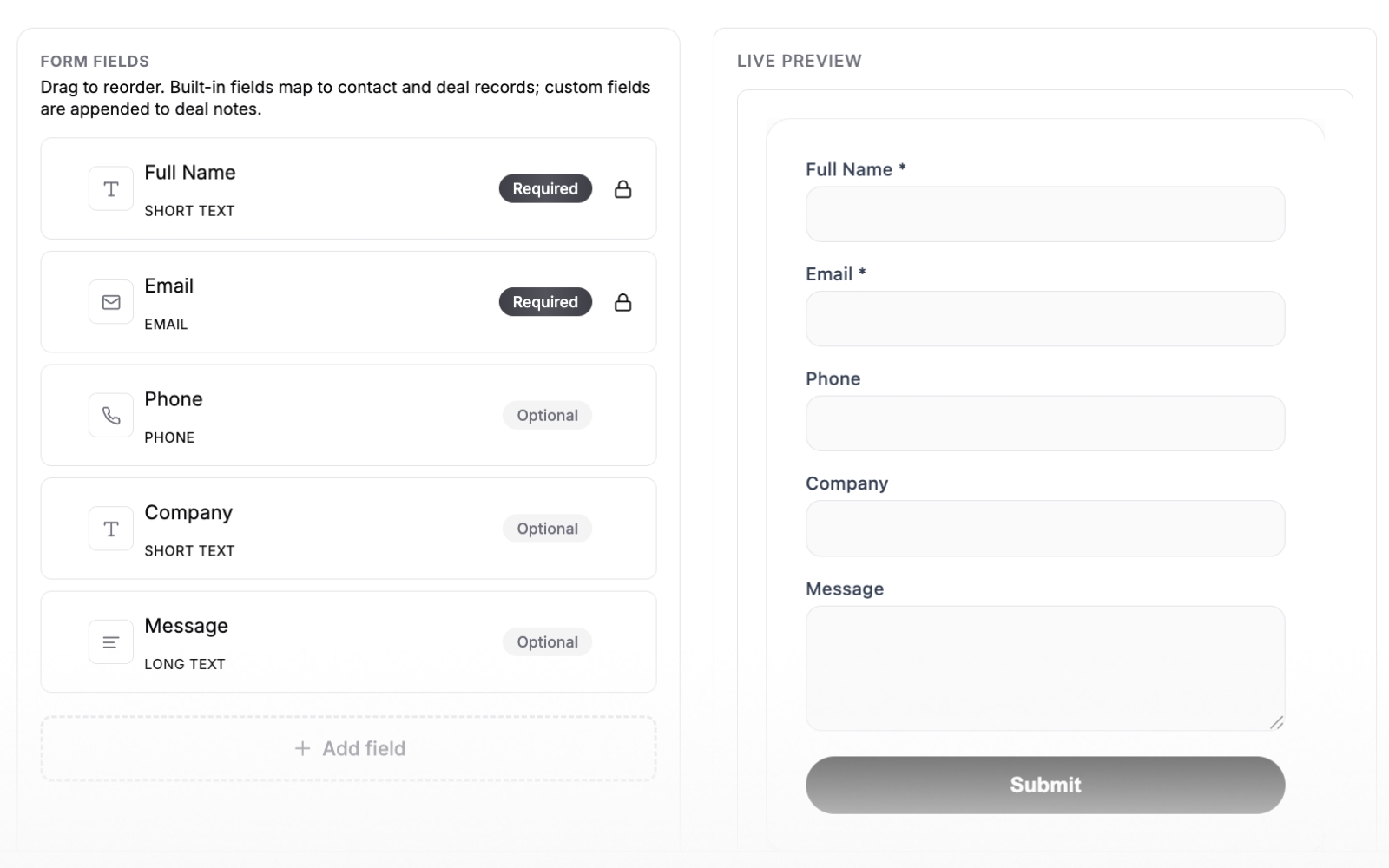
The alert comes through a webhook, which is a message Fluid sends to another app the moment something happens. Every form submission fires one, and Make, Zapier or n8n can turn it into a post in your team’s Slack channel or a text to whoever is on leads that day. That shared message is where the 10-minute claim rule from the rotation happens.
The daily digest is a different tool. Fluid CRM emails each person a list of their reminders due that day, at 9:00 in their own time zone, and it is a backup, not an alert. HBR’s authors named checking for new leads once a day as one of the reasons companies respond slowly, so never let a morning email be the first time anyone sees a lead.
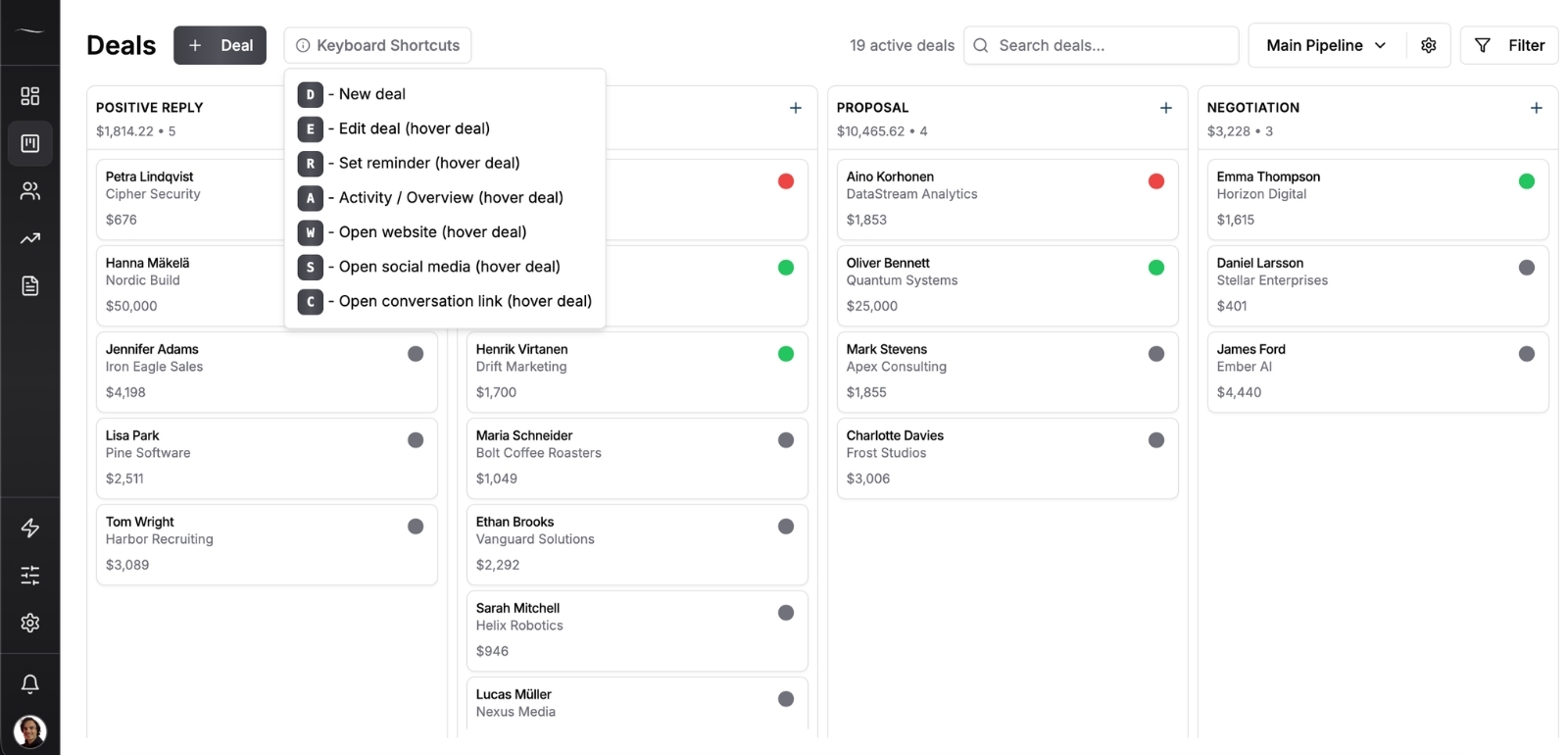
Each deal holds one reminder with a date, and that reminder is what puts the lead into tomorrow’s digest. So the first reply always ends with setting the next one, which takes one keypress (R on a hovered deal). A lead with no reminder stays on the board but never shows up in anyone’s morning email.
Viktor Otterskog, an outbound operator who uses Fluid CRM for outreach follow-up, summed up why that matters in his review, “Reminders for action. Simplistic to ‘play the outbound game’.” The reminder is the action, and the digest makes sure someone sees it.
Two limits matter for this setup. Fluid has no built-in text message or phone notification of its own, so the instant alert needs that webhook and a tool like Make. And there is no dialer, so calls happen from your phone. For a wider look at catching every inbound source, see our posts on lead tracking software and CRM for lead generation.
Frequently Asked Questions
The 5 minute rule says you should call or email a new inbound lead within five minutes of it arriving. It comes from the Lead Response Management Study, which found the odds of qualifying a lead fell 21-fold between a 5-minute and a 30-minute first call. For a small B2B team it is a realistic target for demo and quote requests during business hours.
For a small B2B team, 5 minutes is good for demo and quote requests during business hours and one business hour is good for a positive reply to a cold email. Referrals and LinkedIn messages can wait until later the same day. Outside business hours, a clear promise such as a reply by 9:30 the next morning works better than a target nobody can keep.
It matters more, because each lead is a bigger share of your pipeline. A team that gets four inbound requests a week and loses one to a slow reply has lost a quarter of its inbound demand. Low volume also makes the rotation easy, since nobody gets too many alerts.
No. An auto-reply confirms the message arrived and sets expectations, which is useful outside business hours. Speed to lead is measured to the first reply from a person that answers what the buyer asked.
Take your last 10 inbound leads and write down when each one arrived and when a person first replied. Use the median, the middle value, rather than the average, because one weekend lead skews an average badly. Repeat it every week and you will see whether your rotation and alerts work.
Set Up Your Speed to Lead Routine This Week
You need one shared alert, a rotation with a fallback, an after-hours promise and a weekly 10-lead check, and none of it needs extra software beyond a place for leads to land. If you want inbound leads and every open deal on one board your whole team checks, see how Fluid CRM works as a sales team CRM.
Start your 7-day free trial here, no credit card required.