

Ask your team why the last five deals were lost and you’ll hear five confident answers, most of them “price”. Nobody wrote a reason down on the day the deal ended, so the team goes with a guess.
Win-loss analysis is a regular review of why deals were won or lost. For a small team it means picking one reason from a fixed list the moment a deal closes, writing the buyer’s own words next to it and counting the reasons once a month. Fluid CRM lets you pick the reason when you mark a deal lost.
Most guides describe the version run by software companies with a product marketing team, who hire outside interviewers, send a survey after every decision and buy software to read the results. That suits a company closing hundreds of deals a quarter, not three people closing ten a month.
A small team needs three parts. A reason gets picked when the deal closes, the reasons get counted once a month and a few lost buyers get a phone call each quarter. The first part does almost all the work, and it takes under a minute per deal.
It only happens if the reason lives somewhere the whole team already opens. A sales team CRM that asks for the reason the moment you close the deal gets you a reason on nearly every deal, while a shared doc you promise to fill in on Friday gets you a few. For the formulas that turn won and lost counts into percentages, see our guide to win rate vs close rate.
A Lost Deal Reasons List You Can Copy, and What to Record
Copy this list into wherever you track deals. Eight reasons is enough to tell causes apart and few enough that nobody has to think for more than a second.
| Lost reason | What it means | What it usually points to |
|---|---|---|
| No decision | They kept doing what they did before | A missing question at discovery about what happens if they change nothing |
| Chose a competitor | They bought from someone else | Write the competitor’s name every time |
| Price or budget | They wanted it and couldn’t pay for it | Check the test below before you pick this one |
| Timing | The project moved and never came back | A deal that needs a reminder on the date they gave |
| Not a fit | You should not have taken the call | Who your outreach and forms let in |
| Missing feature or service | They needed something you don’t offer | Product or service gaps, if it repeats |
| Our process | We replied slowly, missed a follow-up or gave a weak demo | Your own habits, and the cheapest row to fix |
| Went quiet | No answer after their date and two check-ins | Deals that were dead long before you closed them |
Keep “Other” as a ninth option with a short note. If more than 1 in 10 losses lands there, the list is missing a row.
Some guides cap the list at five. On a small team I’d keep “No decision” and “Went quiet” apart, because the first is a buyer who chose to do nothing and the second is a buyer you lost track of. The fix for each is different.
The price test
Before you pick “Price or budget”, ask whether they would have signed at a 20% discount. If yes, it was price. If no, they didn’t see enough value, and the real reason is usually one of the other rows.
Buyers often say price on the way out because it’s the easiest thing to say. Our post on common sales objections covers what to do with that answer while the deal is still open.
What to write down on every closed deal
Pick one primary reason per deal, then fill in the rest of the row. It takes the deal owner a minute at most if it happens within a day of the decision.
| Field | Example | Why it matters |
|---|---|---|
| Outcome and close date | Lost, March 12 | Puts the deal in the right month |
| Primary reason | Chose a competitor | The thing you count |
| Buyer’s words | “They could start next week and you couldn’t.” | Shows what the reason actually means |
| Stage it ended at | Proposal sent | Shows where deals die |
| Alternative they picked | A named competitor, a spreadsheet or nothing | Tells you who you really compete with |
| Deal value | $4,800 | Small losses and big losses rarely share a cause |
| Company size | 12 people | Shows which buyers fit |
| Lead source | Referral | Some sources bring in buyers who never buy |
| Who decided | The owner, not the person you spoke to | Tells you who to talk to next time |
Won deals get the same row, with the reason they picked you. A review that only looks at losses can tell you what hurts and never what works.
Lost or Paused? How to Tell Before You Close the Deal
Lost and paused deals get mixed up in every CRM, Fluid CRM included.
A deal is lost when the buyer decided against you, or when the date they gave passed and two check-ins got no answer. A deal is paused when the buyer gave you a reason and a date, like “after our funding round in March”.
Ask three questions before you close one out:
- Did they say later rather than no?
- Did they give you a date?
- Would you still call them on that date?
Three yeses means paused. Add a “Paused” stage at the end of your pipeline, keep the deal open there and put a reminder on their date, so it stays out of your lost counts. The trade is that paused deals stay in your pipeline total.
If you would rather keep that total honest, close it as lost with “Timing” instead. Fluid CRM keeps the reminder on a lost deal, so it still comes back on their date.
If their date passes and two check-ins get no answer, close it as lost with “Timing” or “Went quiet”.
Deals marked lost with no reminder cost you twice. Nobody calls them again, and they make your reason counts wrong. What to send a paused buyer while you wait is covered in our guide to lead nurturing for small business.
How many deals in your Lost column would pick up the phone if you called them on Monday?
The 30-Minute Monthly Win-Loss Review, With a Worked Month
Book the review for the first week of each month and make sure whoever owns the business joins it. Only deals that closed get looked at, because open deals belong in your weekly sales pipeline review.
Here is a made-up month for a three-person agency, to show what half an hour with last month’s closed deals produces. It won 6 deals and lost 11.
| Lost reason | Deals | Lead source of those deals |
|---|---|---|
| No decision | 4 | 3 from a cold email campaign |
| Chose a competitor | 3 | Mixed |
| Price or budget | 2 | Mixed |
| Our process | 2 | Both were inbound leads answered the next day |
Step 1: count the reasons, won next to lost
Lay out the reasons for the 11 losses next to the reasons for the 6 wins. Here, five of the six wins were referrals and the wins kept citing “they already knew our work”. That one line says more about where to spend next month than the loss counts do.
Step 2: read the buyer’s words for the top two reasons
The four “no decision” deals all said some version of “not a priority right now”. Three came from the same cold email campaign. The list brought in people who were curious and not ready to move.
Step 3: pick one change and give it an owner
The team adds one discovery question, “What happens if you leave this as it is for six months?”, and marks any lead that can’t answer it as Not a fit early. The founder owns the change and checks it at the next review. The two “Our process” losses wait for next month, so the team only changes one thing at a time.
Step 4: check last month’s change and read three months together
Say last month’s change was asking every new lead about budget on the first call. Count whether “Price or budget” losses dropped before you add anything new.
With 11 losses a month, one month can mislead you. Look at the last three months side by side before you call anything a pattern. If one competitor shows up in half your losses or more across those three months, treat it as a problem with your offer rather than with one deal.
The same reasons tell you which stages you’ve been too hopeful about, so feed them into your next sales forecast.
Paste this checklist into the calendar invite:
- Every deal closed last month has a reason and the buyer’s words
- Reasons counted, won next to lost
- Top two reasons read in the buyer’s words
- One change picked, with an owner and a date
- Last month’s change checked against this month
10 Questions to Ask Buyers Who Said No
A call with a lost buyer tells you what a lost reason list can’t. Ask within two weeks of the decision, keep it to 15 minutes and say up front that you won’t try to sell. It works best when the founder asks, or someone who didn’t sell to them.
An example of the email:
Hi Sam, thanks for being straight with us about choosing another option. Could I have 15 minutes next week to hear what we could have done better? I won’t pitch you anything, I just want to fix it for the next person.
Many won’t reply, and that is fine. Three good calls a quarter will teach you more than a survey nobody fills in.
About the decision
- What made you start looking in the first place?
- Who else had a say in the final choice?
- What did you end up doing instead?
About the other option
- What almost made you pick us?
- What did the option you chose do better?
- How did our price compare with what you expected to pay?
About us
- At what point did you start leaning away from us?
- Was there a moment you felt we weren’t listening?
- If you ran our sales process, what would you change first?
- Would it be all right to check in when things change on your side?
Ask two won customers a quarter the first five questions as well. Their answers are the reasons you want more of.
How to Track Win-Loss Analysis in Fluid CRM
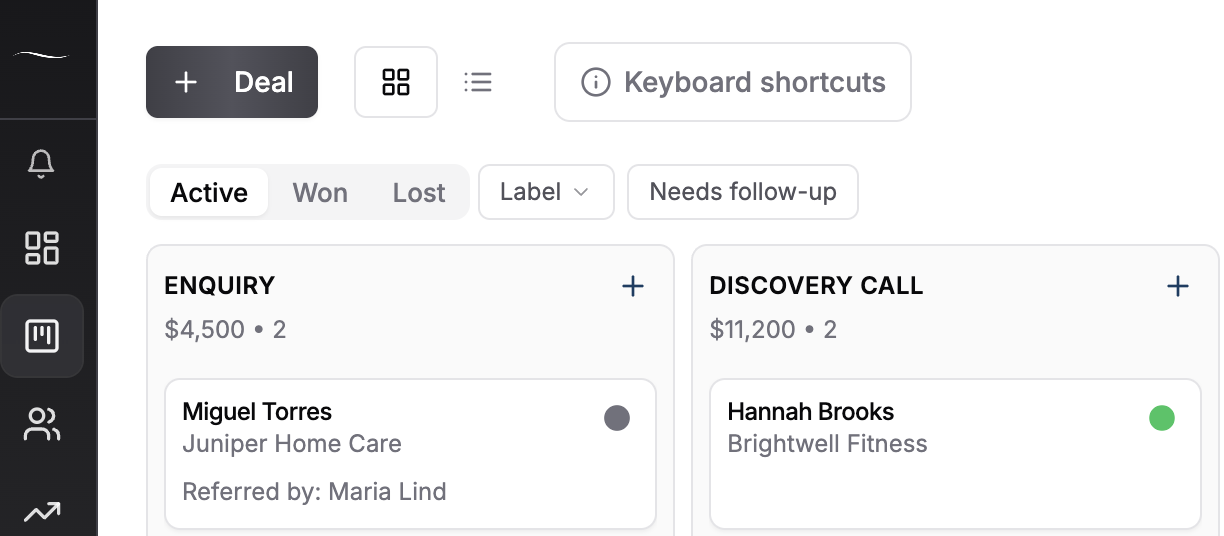
When you mark a deal lost, Fluid CRM asks you to pick a reason from your list. The workspace owner can rename, reorder or archive the reasons, so you can shape the list to match the one above. An “Other” reason takes a short note.
Reports has a lost reasons view you can filter by pipeline and date range, with a Results tab next to it.
The setup takes four steps:
- Rename the lost reasons to match the list above as closely as you can.
- Add a “Paused” stage at the end of your pipeline and put a reminder on each paused deal.
- Write the buyer’s words in the deal note when you close it.
- Open the lost reasons report with last month’s dates at the start of each review.
None of those four steps needs a consultant or an afternoon of setup. Yannick, a Fluid CRM customer, put his first impression in the title of his review, calling it “powerful, intuitive, and ready to use right away.”
If you use Claude or ChatGPT, the Fluid CRM connector lets it read your lost deals with their notes and lead sources. Ask it to group your lost deals’ notes by theme before the review and you walk in with the reading done.
Two limits matter here. Each deal has one contact, so write who made the final decision in the note when it wasn’t the person you spoke to. Fluid CRM has no survey or interview tool either, so buyer calls get booked by email and your calendar.
FAQ
Win-loss analysis is a regular review of why your deals were won or lost. You record a reason when each deal closes, count the reasons over time and talk to a few buyers. The goal is one change a month based on what buyers actually did.
There is no fixed number, but one month of a small team’s losses can easily mislead. Read three months together before you call something a pattern. A reason that keeps coming up across those months is worth acting on.
Yes. Won deals show what buyers liked, and losses alone can’t tell you that. Record the same fields for both and ask a couple of new customers why they picked you.
The founder or someone who wasn’t selling to that buyer. Buyers are more honest with a person whose feelings they don’t have to protect. Keep it short and promise not to pitch.
The reasons that come up most are usually no decision, a competitor, price and deals that went quiet. Your own list will differ, which is why you count it yourself rather than trusting a general ranking.
Start With Last Month’s Lost Deals
Open every deal you lost in the last 30 days and give each one a reason from the list above, plus a line in the buyer’s words where you remember them. Reopen any that were only paused, move them to the Paused stage and give each one a date. Then put the first 30-minute review in the calendar, and keep every reason in a sales team CRM the whole team already opens.
Start your 7-day free trial here, no credit card required.