
Your pipeline shouldn’t depend on luck, referrals or the one client who keeps coming back. It should be something you build on purpose. I booked over 1,000 B2B meetings and 12M€+ in pipeline for 50+ clients doing exactly that. This post is the process I used, start to finish.
Pipeline generation means creating new sales opportunities and moving them into your pipeline, through outbound, inbound or both. Outbound gives newer businesses predictable pipeline you control. Inbound compounds slower and suits bigger brands. Most startups should lead with outbound.
Pipeline Generation vs Lead Generation
Pipeline generation and lead generation get mixed up all the time, but they solve different problems. A lead is a name that raised a hand. A pipeline opportunity is someone you’ve qualified who has a real chance to buy and is moving toward a decision.
Lead generation fills the top. You collect contacts who showed some interest, whether that’s a form fill, a reply or a connection request. For capturing inbound, see how to create lead capture forms that feed your pipeline.
Pipeline generation is the next job. You take some of those leads, qualify them and move them through real stages until they close or drop out.
This matters because plenty of businesses generate leads and still have no pipeline. They have a list of names sitting in a spreadsheet that nobody works. A real pipeline has motion. Deals enter, deals advance and deals close, and you can see exactly where each one sits. If you only count leads, you’re measuring activity. If you count pipeline, you’re measuring money.
Inbound vs Outbound: Which One Builds Pipeline Faster
Inbound and outbound both build pipeline, but they don’t build it the same way or at the same speed. Knowing which one fits your business right now decides how fast you see results.
Inbound is when people come to you. You publish content and they find you when they’re ready. The usual channels are SEO blog content, YouTube videos, optimizing your pages so AI tools cite you, posting on LinkedIn and even running a podcast. Inbound compounds. It’s slow to start and great once you have volume, which is why it tends to be a big-brand game.
Outbound is when you go to them. You pick exactly who you want to talk to and start the conversation yourself. The channels are cold email, LinkedIn outreach and cold or warm calls. Outbound is predictable and you control the targeting down to the person, but it’s a grind. You don’t wake up to inbound replies. You make them happen.
Here’s my honest take, and it’s one most big vendors won’t give you because they sell to everyone. If you’re a startup or a newer business without an inbound flywheel already spinning, outbound wins. It’s predictable, it’s fast and you decide who lands in your pipeline. Inbound is worth building in parallel because it compounds, but it can’t be your only bet when you need meetings this quarter. Run both if you can. Lead with outbound if you’re starting from zero.
Be honest with yourself for a second. If you stopped all outreach today, would new conversations still show up next month? If the answer is no, you don’t have inbound yet. You have outbound you haven’t started.
There’s one thing to set up no matter which channel you pick. Put a Meta tracking pixel on your website. Then traffic from every channel, cold email clicks, LinkedIn profile visits, podcast listeners, can be retargeted later with low-cost, high-converting ads. It costs nothing to install and it turns one-time visitors into an audience you can reach again. Most founders skip this and lose months of traffic they could have kept.
How To Get Pipeline-Ready Before You Pick A Channel
Before you send a single cold email, your offer, your branding and your sales assets need to be ready. Most people skip this part, fire off outreach and then blame the channel when nobody replies. Running outreach with a weak offer and thin proof is like opening a restaurant with no menu and hoping people order anyway.
Get these three things right first and the channel almost works on its own.
Build an outbound-friendly offer
Your offer is the whole game. A good outbound offer has a specific outcome (what they actually get), a unique mechanism (the different way you get them there) and a clear timeline (how long it takes). If you can add a guarantee and a couple of bonuses, even better, because they remove the risk of saying yes.
Vague offers die in the inbox. “We help companies grow” gets ignored. “We book you 10 qualified sales calls in 60 days using cold email, or you don’t pay” gets a reply. The more specific and the more different your offer sounds, the easier every other step becomes.
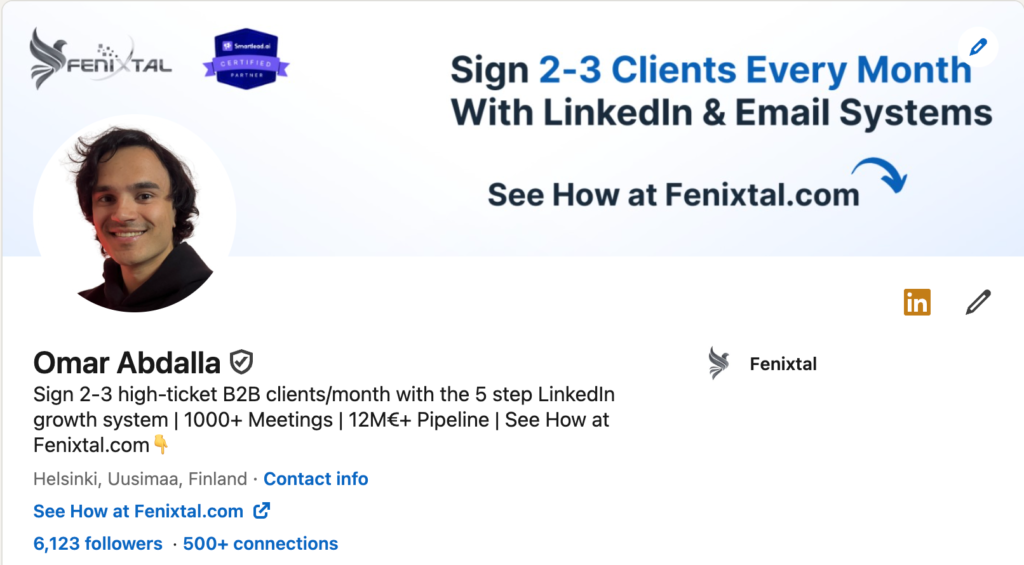
Below is an example of my LinkedIn profile and outbound-friendly offer: Sign 2-3 high-ticket B2B clients/month with the 5 step LinkedIn growth system.
- Offer: 2-3 high-ticket B2B clients
- Timeframe: every month
- Unique mechanism: 5 step LinkedIn growth system
Fix your branding and proof
When someone gets your cold email, the first thing they do is check you out. Your website, your LinkedIn profile, your reviews. If those look weak, the conversation ends before it starts.
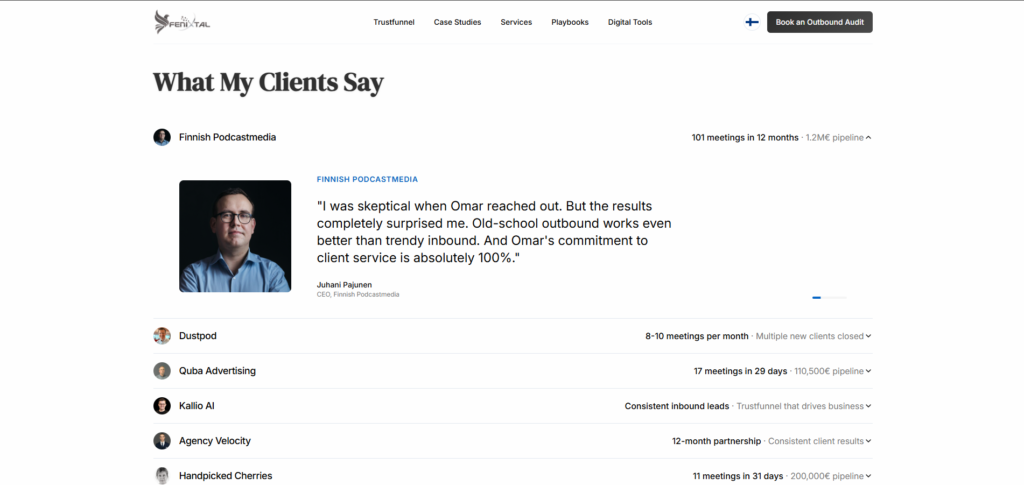
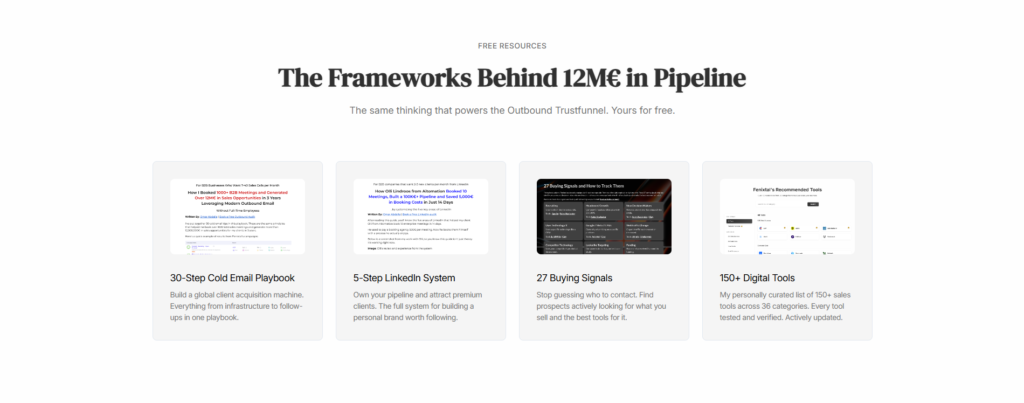
Your website should look premium, not like a free template you never finished. Your LinkedIn profile should be better than your competitors’, because prospects compare. And you should trickle social proof in everywhere: case studies, testimonials and free resources that prove you know your stuff. Proof does the selling that your words can’t.
Create lead magnets and sales assets
The fastest way to stand out in a saturated market is to give value before you ask for anything. Build sales assets you can send upfront that prove your competence. Loom videos walking through an idea, a Gamma deck, a Notion page, a Google Doc with a real plan, anything visual and concrete.
These assets do two things. They show the prospect you’re serious and capable, and they make your outreach memorable in an inbox full of generic pitches. When I needed to win trust fast at Fenixtal, a short personalized video did more than three follow-up emails ever could. If you want help picking what to build, see 12 best sales tools for startups.
How To Choose Your Outbound Channel
Your outbound channel should match three things: your ideal customer, where they spend their time and your own strengths. Pick the channel that fits all three and outreach stops feeling like a fight.
Think about your ideal customer first. Where do they hang out and what are they used to hearing from? A founder who lives in their inbox is reachable by cold email. A sales leader who scrolls LinkedIn all day might respond better to a thoughtful DM. Then add the part most guides ignore, which is you. Your personality and strengths decide what you’ll actually keep doing.
My own stack is automated mass cold email and targeted LinkedIn outreach with warm calls on positive replies. That suits a systems-driven, slightly introverted operator who would rather build a machine than dial all day.
On top of that I send LinkedIn connection requests to anyone who replies positively anywhere. If you’re extroverted and not tech-heavy, cold calling might fit you far better than it fits me. There’s no single right channel. There’s the right channel for your customer and for you.
Cold email
Cold email scales better than anything else and the cost per touch is tiny. You control the volume and the targeting completely, which is why it’s my favorite for predictable pipeline. The trade-off is that it lives or dies on three things: a clean list, good deliverability and a sharp offer. Get those wrong and you’re emailing spam folders. Get them right and it’s a meeting machine. For the full breakdown, see 30-step cold email outreach playbook.
LinkedIn outreach
LinkedIn outreach runs warmer than cold email because people can see your face, your profile and your content before they reply. It’s slower and harder to scale, but it builds more trust per touch. The smartest way to use it is as a layer on top of cold email. When someone replies to your email, send them a LinkedIn connection request too, so you show up in two places at once. The deep dive on how to find clients from LinkedIn lives here: 5-step LinkedIn outreach system.
Cold and warm calling
Calling has the highest friction and the highest trust. A real voice cuts through everything, which is why warm calls to people who already replied convert so well. Cold calling from scratch is brutal and suits extroverts who don’t mind rejection all day. Warm calling, where you call someone who showed interest first, is one of the most underused moves in B2B and it closed plenty of the meetings I booked over the years.
How To Track Your Pipeline So It Doesn’t Leak
Generated pipeline is worthless if you can’t see it, so the last step is tracking every opportunity in a CRM. This is where most of the work you just did gets wasted. You book the meetings, the replies pile up and half of them slip because nobody followed up in time.
Fluid CRM was built for exactly this point in the process. You get a visual pipeline that shows every deal and what needs attention today, instead of a flat spreadsheet you stop trusting. Reminders make sure nothing slips, which is the whole reason deals fall through. It’s fast with keyboard shortcuts so logging an activity takes seconds. And it connects by API to cold email tools like Smartlead and Instantly, so positive replies land as deals automatically without you copying anything by hand.
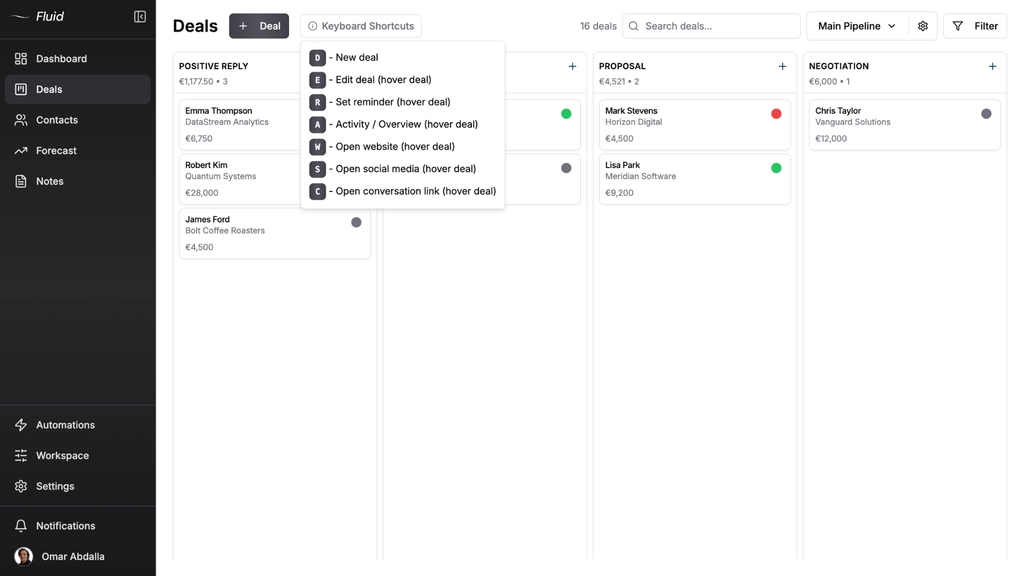
Viktor Otterskog, a solo B2B outbound operator in Sweden, runs the same loop every day in Fluid: he opens a deal, takes action by calling emailing or messaging on LinkedIn, logs what happened and sets the next reminder. He called the fast and visual reminders “a seriously smart thing,” and for a one-person outbound shop that reminder is the difference between a deal that closes and a deal that dies.
If you’re picking a tool for outbound specifically, I broke down the options here: best CRM for cold email and best CRM for outbound. If you’re tired of watching good replies go cold in a messy spreadsheet, Fluid CRM gives you a clear visual pipeline that keeps every deal moving. 7-day free trial, no credit card required.
Frequently Asked Questions
Pipeline generation is the work of creating new sales opportunities and moving them through your pipeline toward a close. It’s broader than lead generation, which only fills the top with contacts. Pipeline generation covers picking who to target, starting the conversation, qualifying the lead and tracking the deal until it’s won or lost.
The 10-3-1 rule is an old funnel rule of thumb that came out of life insurance sales. The basic idea is that for every 10 qualified prospects you work, about 3 turn into real conversations or proposals and 1 becomes a sale. The exact labels shift depending on who you ask, but the point holds: you need volume at the top to get one deal at the bottom, so consistent activity matters more than any single outcome.
Start with the fundamentals before the channel. Fix your branding and proof, build a specific offer and create a few valuable sales assets you can send upfront. Then pick one outbound channel that fits your customer and your strengths, whether that’s cold email, LinkedIn or calling. Track every reply in a CRM with reminders so nothing slips, and keep the activity consistent until deals start moving.
It depends on your channel and how dialed-in your offer and list are. Outbound is the fast option because you control the volume, so a tight cold email or LinkedIn campaign can start booking meetings within weeks. Inbound takes longer because it compounds over months. The honest answer is that the first meetings come quickly once your fundamentals are right, and the predictable, repeatable pipeline comes from doing it every week without stopping.
Conclusion
Pipeline you build on purpose beats pipeline you wait for. Get your offer, branding and assets right, pick the outbound channel that fits your customer and your own personality, then track every opportunity so none of it leaks.
Do that consistently and the problem flips from finding pipeline to choosing who you actually want to work with. If you want a calm visual pipeline that keeps your deals moving instead of slipping, Fluid CRM is built for it. 7-day free trial, no credit card required.
I ran this exact process across dozens of B2B industries at my outbound agency Fenixtal, before it ever became a blog post.