

Search “CRM for accountants” and every list hands you one big all-in-one suite. That’s the wrong frame. Accountants and bookkeepers do two different jobs, and those jobs need two different tools. One serves the clients you already signed. The other wins the clients you haven’t.
The best CRM for accountants depends on the job. Practice management software like TaxDome, Karbon or Financial Cents runs the work for signed clients. A sales CRM like Fluid CRM wins new ones, tracking every prospect, quote and follow-up for $16 per seat per month. Most accounting firms need one of each.
Accounting CRM vs Practice Management Software
An accounting CRM and practice management software solve two different jobs, even though both get sold under the same word. Anyone shopping for a CRM for accounting firms is usually trying to fix one of those jobs without knowing the other exists.
Job one is serving the clients you already signed. Document collection, client portals, e-signatures, tax organizers and billing all live here. This is practice management, and tools like TaxDome, Financial Cents, Karbon and Canopy are built for it.
Job two is winning the clients you haven’t signed yet. Tracking a prospect from first call to closed deal, remembering to follow up a few days after the first call and seeing your whole pipeline on one screen. This is a sales pipeline, and it’s a different tool with a different purpose.
Almost every CRM list for accountants blurs these two jobs into one tool, and that’s where the confusion starts. There’s a gap nobody in these lists points out. The “CRM” inside a practice management platform is really a client database. It holds the people you already work for. It is not a pipeline for the people you’re trying to win. Law firms face the same split, which I broke down in 9 best CRMs for law firms.
I’ve seen this split up close. Across 50+ B2B clients at Fenixtal, where I’ve run cold email and LinkedIn outreach for 3 years, most firms tracked new business one of two ways. Either nothing at all, or a heavy tool they paid for and never opened. The compliance and consulting firms I worked with landed in exactly the same place as accounting firms do. They buy practice management to run client work, then track new prospects in their head or a forgotten spreadsheet.
Picture a bookkeeper who signs 3 referrals in a month, books 2 and loses the third because it lived in an email thread nobody reopened. That’s not a client-work problem. The practice management tool would have served that client beautifully once signed. The firm just never had a pipeline to win them in the first place.
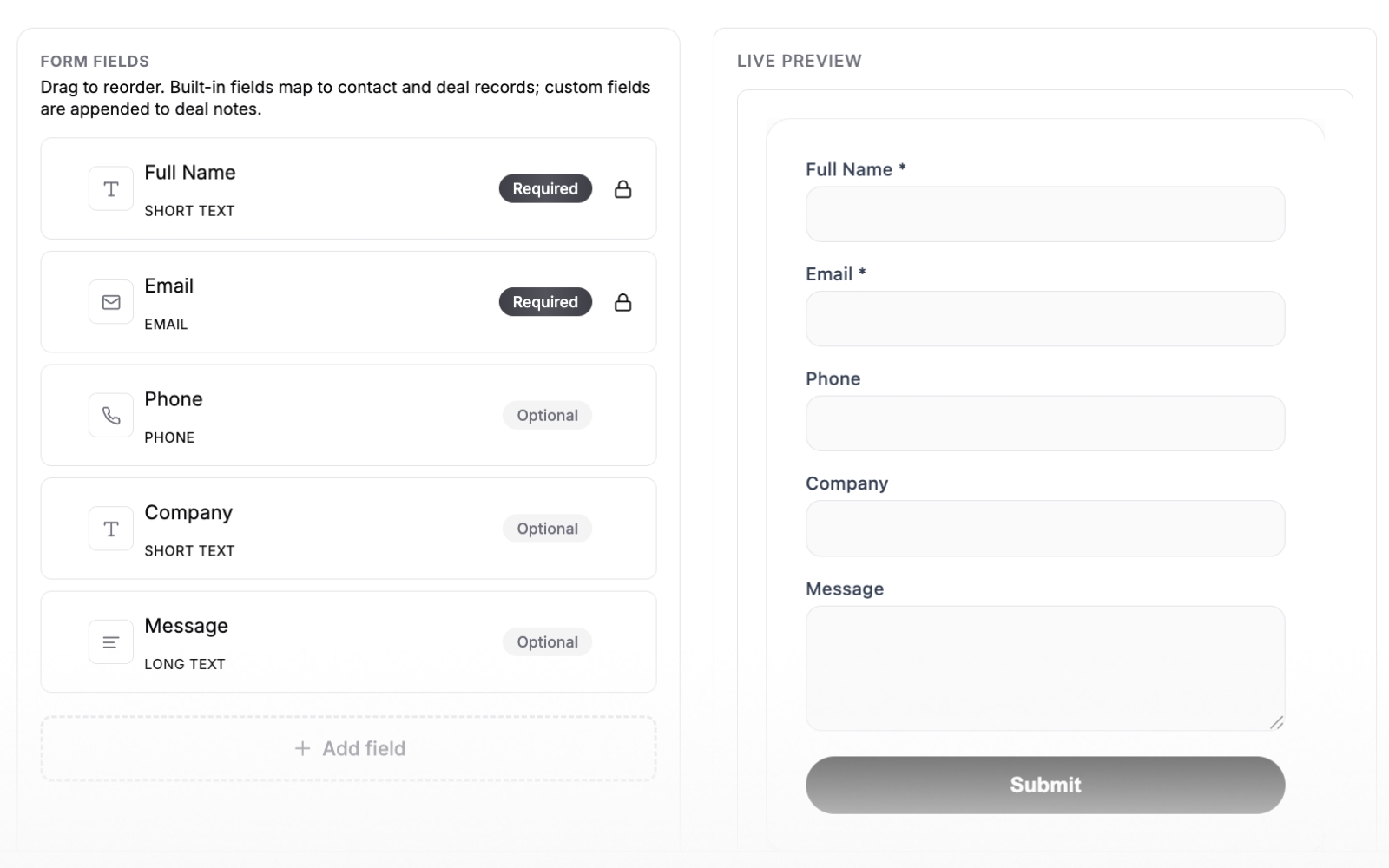
Ritz Steytler runs Abacus Partners, a UK consultancy. He isn’t an accountant, but the intake problem is identical, and he uses an embedded lead form so inquiries land in his pipeline instead of his inbox. He called Fluid CRM “a really nice, simple, easy-to-use tool.” Nothing about that setup needs accounting-specific software. It needs a place for new business to land.
So the 10 tools below are split by job. Four practice management platforms for client work, then 6 sales pipelines for winning new clients, with the best pick of that group called out.
| CRM | Job it does | Best for | Starting price |
|---|---|---|---|
| TaxDome | Practice management | Tax-heavy firms | $800/seat/year, annual only (about $67/seat/mo) |
| Financial Cents | Practice management | Bookkeepers and small firms | $19/seat/mo Solo (annual billing) |
| Karbon | Practice management | Firms of 3+ needing workflow | $79/seat/mo Team ($59 annual) |
| Canopy | Practice management | Tax resolution and CPA work | $74/seat/mo Standard (annual billing) |
| Fluid CRM | Sales pipeline | Winning new clients | $16/seat/mo ($144/seat/year) |
| OnePageCRM | Sales pipeline | Cheapest serious pipeline | $9.95/seat/mo (annual billing) |
| HubSpot | Sales pipeline | Free CRM plus marketing | Free tier, $20/seat/mo Starter (monthly billing) |
| Zoho CRM | Sales pipeline | Firms already on Zoho Books | $20/seat/mo Standard ($14 annual) |
| Capsule | Sales pipeline | Free tier to start | $22/seat/mo Starter ($18 annual) |
| Pipedrive | Sales pipeline | Deeper sales automation | $24/seat/mo Lite ($14 annual) |
Practice management tools run the client work. Sales pipelines win the work. The rest of this post breaks down each one.
The 10 Best CRMs for Accountants and Accounting Firms
TaxDome
TaxDome is the heavyweight all-in-one for tax and accounting firms that want client portals, document collection, e-signatures, workflows and billing in one place. If your bottleneck is serving clients, not finding them, this is the practice management pick most tax-heavy firms land on.
Pricing is annual only and billed upfront. Essentials is $800 per seat per year, Pro is $1,000 and Business is $1,200, with 2 and 3-year commitments knocking roughly 6% to 12% off. Do the firm math before you commit, because Essentials is single-user. A 3-person firm can’t use it at all and lands on Pro at $3,000 a year. Pro also lets you add monthly seats for seasonal staff at $100 each, which is the one flexible piece of the pricing.
Where it fits: established tax firms with the volume to justify an all-in-one and the patience to set it up.
Where it falls short: It is not a sales pipeline. Its CRM is built to manage clients you already have. The contact list shows every client you’ve onboarded, but it won’t tell you which prospect you forgot to call back last Tuesday. There’s also no free trial and no free tier, so evaluation runs through a demo and a year of spend committed upfront.
Financial Cents
Financial Cents is the most affordable full practice management platform for bookkeepers and small firms. It covers recurring workflow templates, a passwordless client portal, time tracking, billing and a QuickBooks Online sync, all built for the way bookkeeping work repeats month to month.
Solo is $19 per month for a single user on annual billing. Team is $69 per seat monthly, dropping to $49 on annual, and Scale is $89 monthly or $69 annual. Read that carefully if you’re a 2-person firm, because monthly billing requires a minimum of 5 users. A pair of bookkeepers who want Team either pay for 5 seats monthly or commit to a year at $49 each. There’s a 14-day free trial with no card required.
Where it fits: bookkeepers and small firms that want professional client workflows without TaxDome money.
Where it falls short: Like the others in this group, it manages the clients you have. It won’t run your new-business pipeline. It tracks the monthly close for clients you’ve signed, not the 5 warm leads sitting in your inbox waiting on a proposal you keep meaning to send. The 5-user minimum on monthly billing also punishes exactly the small teams the Solo plan is aimed at.
Karbon
Karbon is the workflow-first practice management platform built around a shared team inbox. Client emails, tasks and jobs live in the same place, so the work moves without anyone chasing a status update in a group chat. It’s a serious name in accounting and it’s aimed squarely at firms with staff, not solo operators.
Team is $79 per seat monthly or $59 on annual. Business is $99 monthly or $89 annual, and monthly billing on either plan needs at least 4 users. A 5-person firm on annual Business pays $445 a month, or $5,340 a year. The features most firms want, including automatic client reminders and task automation, sit on Business rather than Team, so budget for the higher tier. Enterprise is a custom quote and there’s no free tier.
Where it fits: firms of 3 to 50 people where several staff touch the same client work and email coordination has stopped scaling.
Where it falls short: A solo bookkeeper is paying team-collaboration prices for features one person can’t use. The entry Team plan caps you at 40 work templates and 1,000 contact profiles, which growing firms hit. And like every tool in this group, its client records are a database of signed clients, not a pipeline of prospects.
Canopy
Canopy is the practice management platform built around tax resolution and IRS work, with transcript pulls and notice tracking available on top of the core platform.
Standard is $74 per seat per month on annual billing, and it includes the full platform. Plus is $109 and Premium is $149 on the same annual terms, while Enterprise is custom. A 5-person firm on annual Standard pays $370 a month. Tax Resolution is a separate add-on at $50 per seat per month on annual billing, so a firm putting 2 staff on notices adds $100 a month on top.
Where it fits: CPA and tax-resolution firms that want IRS tools and one platform for the whole practice.
Where it falls short: The entry price is the highest per seat of any practice management tool here, which makes it a hard sell for a 1 or 2-person bookkeeping shop. The client engagement piece is a database for existing clients, not a sales pipeline for new ones.
Fluid CRM
Fluid CRM is the pick for the other job, winning new clients. It’s a simple visual pipeline built for solo founders, consultants and small B2B teams who’ve outgrown a spreadsheet but don’t want a heavy suite. For an accountant or bookkeeper, that means tracking every prospect from first conversation to signed engagement, with a reminder on every deal so no prospect gets forgotten.
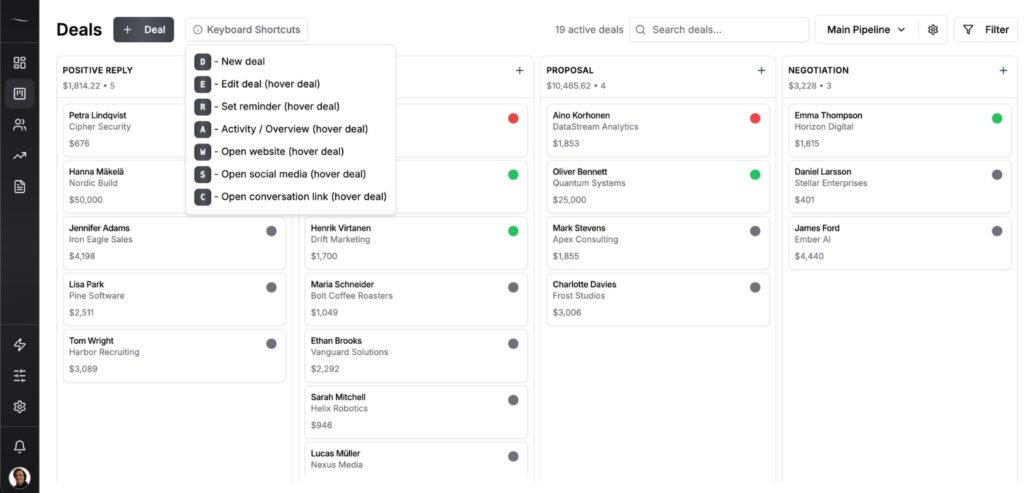
Pricing is $16 per seat per month, or $144 per seat per year with 3 months free on annual. Every feature is included on both plans, with no upgrade traps and no feature unlocks. You pay per seat, never for a tier. A 3-person firm pays $48 a month, and the third seat costs exactly what the first one did. A 5-person firm pays $80 a month, or $720 a year on annual billing. There’s a 7-day free trial, no credit card required.
The reminders are the part that saves deals. When a prospect says “check back after tax season,” you set a reminder and Fluid surfaces it on the right day, so the quote you sent in March doesn’t quietly die in your inbox by June. Deals can be assigned per owner, so a 2-partner firm can see who’s carrying which prospect without two people calling the same referral.
Where it fits: any accounting or bookkeeping firm that’s serious about winning new clients and tired of losing them to a missed follow-up. Pair it with your practice management tool. One wins the work, the other delivers it. Here’s how Fluid CRM works as a CRM for consultants and coaches, the closest fit to advisory work.
Where it falls short: Fluid CRM does not do client portals, document management, e-signatures, time tracking or billing, and it does not sync with QuickBooks or Xero. It is not practice management and won’t replace TaxDome or Financial Cents for client work. There’s also no free tier and no marketing automation, so firms wanting nurture sequences will need something else.
Best for: Accounting and bookkeeping firms of 1 to 10 people that win clients through referrals and quotes and need every prospect followed up until they sign.
OnePageCRM
OnePageCRM is the cheapest serious sales pipeline on this list, built around a “Next Action” system that forces every contact to have a defined next step with a date. For an accountant who forgets follow-ups rather than losing data, that fixes the main problem.
Professional is $9.95 per seat per month on annual billing, which includes 4 months free versus paying month to month. Business costs about twice as much and adds multiple pipelines and deeper reporting. There’s a 21-day free trial with no credit card required, which is the longest trial in this group.
Where it fits: solo accountants and bookkeepers on a tight budget who want a real pipeline and follow-up discipline for under $10 a seat.
Where it falls short: The interface shows its age next to newer tools, and the Action Stream gets unwieldy if you stop maintaining dates, which makes your whole book look overdue. Multiple pipelines require the Business plan, so a firm wanting to separate tax prospects from advisory prospects pays double the entry price. We put the two side by side in Fluid CRM vs OnePageCRM.
HubSpot
HubSpot offers a free CRM that works if you also want marketing tools under the same roof. The free tier covers up to 2 users and basic contact and deal tracking, which is enough for a solo accountant trying out on new-business tracking.
The cost shows up when you grow. Starter runs $20 per seat on monthly billing, but the features most firms actually want, like sequences, automation and real reporting, sit on Professional at $100 per seat monthly ($90 on annual), plus a one-time $1,500 onboarding fee that isn’t optional. A 3-partner firm on Professional pays $300 a month plus that onboarding bill, so year one lands near $5,100. That’s a real jump for a small firm that just needs to follow up with prospects.
Where it fits: accounting firms that genuinely run marketing campaigns and want the CRM and the marketing tools in one system.
Where it falls short: The gap between Starter and Professional is the trap. Firms sign up free, outgrow it, then discover the features they came for are 5x the Starter price with a mandatory onboarding fee attached. If you’re weighing it seriously, here’s whether HubSpot is worth it by team type.
Zoho CRM
Zoho CRM is the natural pick if your firm already runs on Zoho, because Zoho Books sits in the same ecosystem and the two products share a login and a contact record. That’s a real advantage nobody else on this list offers for accounting work specifically.
The free edition covers up to 3 users. Standard is $20 per seat monthly or $14 on annual, Professional is $35 monthly or $23 annual and Enterprise is $50 monthly or $40 annual. A 5-person firm on Standard pays $100 a month on monthly billing or $70 on annual. Process automation through Blueprint starts at Professional, and the Zia AI features start at Enterprise.
Where it fits: firms already using Zoho Books or the wider Zoho suite, and price-sensitive teams who want a lot of configurability for the money.
Where it falls short: Zoho is famously fiddly to configure. The flexibility that makes it powerful means somebody in the firm has to own the setup, and small accounting firms rarely have that person. Zoho Books is also a different product on a separate subscription, so “Zoho does accounting too” costs more than the CRM line item suggests.
Capsule
Capsule is a simple sales CRM that even keeps a page aimed at accountants. It’s clean, easy to learn and covers contacts, pipelines and basic tasks without much setup, which makes it a fair pick for a small firm tracking new business.
There’s a free tier for up to 2 users and 250 contacts. Starter is $22 per seat monthly or $18 annual, Growth is $40 monthly or $36 annual and Advanced is $60 monthly or $54 annual. The free plan is a real way to test it, but it stops at 2 users. The moment a third person needs access, a 3-person firm is paying $66 a month on Starter. Workflow automation and multiple pipelines live on Growth, so most firms that stay end up there.
Where it fits: 1 or 2-person firms that want to start free and don’t need automation on day one.
Where it falls short: The tiering is where the real cost hides. Starter covers contacts, one pipeline and tasks, and not much beyond that. Two-way email sync and marketing automation aren’t strengths, and email campaigns require a separate add-on product billed on top.
Pipedrive
Pipedrive is a sales-focused CRM with deeper automation than most tools on this list, built for teams that want to customize their pipeline and automate sales tasks. For an accounting firm with a dedicated person chasing new business, it’s a solid sales-first option.
Lite is $24 per seat monthly or $14 on annual. The catch is that Lite skips email sync, automation and forecasting, so most teams that want the automation end up on Growth at $49 per seat monthly ($39 annual). A 3-person firm on Growth pays $147 a month on monthly billing. Premium is $79 monthly or $59 annual, and add-ons like LeadBooster are billed separately on top of the base plan.
Where it fits: firms with someone whose actual job includes new business and who will use the automation they’re paying for.
Where it falls short: Lite is a demo plan wearing a price tag. It has no email sync and no automation, which is most of why a firm buys a CRM over a spreadsheet. Pick Pipedrive if you want heavier sales automation and you have someone to set it up. Pick Fluid CRM if you’d rather open the tool, see your pipeline and get back to client work in 2 minutes.
Best CRM for Bookkeepers
A bookkeeping CRM has a simpler job than one built for a tax firm, because the shape of the work is different. New business arrives by referral, not by campaign, so it helps to know how to ask for referrals before you need them. Volume is low, deal values are steady and the whole job is not losing track of the 3 or 4 conversations you have open at any time.
Fluid CRM is the best fit for most bookkeepers at $16 per seat per month with every feature included. A solo bookkeeper or a 2-person team gets a visual pipeline, reminders on every deal and no tier to graduate into. OnePageCRM is the cheaper option at $9.95 per seat on annual billing if budget is the binding constraint and you can live with an older interface. Solo consultants outside accounting hit the same wall and fix it the same way, which I broke down in CRM for consultants.
For the client-work half, Financial Cents at $19 a month is built for exactly this. Recurring monthly close templates, a client portal and a QuickBooks Online sync cover the bookkeeping workflow without TaxDome or Karbon money.
Skip Karbon and Canopy here. Both are priced for firms with staff and you’d be paying for team coordination features that a 1 or 2-person operation can’t use. A bookkeeper running $370 a month through Canopy Standard is funding a workflow engine built for a 20-person practice.
Best CRM for Small Accounting Firms
Once a firm has 2 to 10 people, the CRM question changes from “will I remember to follow up” to “who owns this prospect.” That’s the point where a CRM for accounting firms has to do something a solo tool doesn’t. Two partners calling the same referral is worse than nobody calling. Seat cost also stops being a rounding error, because every number on this page multiplies by headcount.
Run the math before you pick. A 5-person firm pays $80 a month on Fluid CRM, $100 on Zoho CRM Standard monthly, $110 on Capsule Starter, $245 on Pipedrive Growth or $500 on HubSpot Professional plus a $1,500 onboarding fee in year one. That spread is $420 a month between the cheapest and the most expensive, which is a staff bonus or a marketing budget.
What actually matters at this size is deal ownership and handoffs. A partner takes the intake call, a senior does the scoping, somebody sends the engagement letter. If the tool can’t show who owns which deal and surface an overdue follow-up to the right person, the pipeline lives in whoever’s memory is best. Fluid CRM assigns an owner per deal and keeps the reminder with them, and every seat costs the same $16 with no feature tier to argue about.
On the practice management side, Karbon earns its price once several staff touch the same client, because the shared inbox is what stops the “did you reply to them or should I” loop. Below 3 people, it’s overkill.
How to Choose a CRM for Your Accounting Firm
Most CRM software for accountants gets sold on long feature lists. A firm of 1 to 10 people needs far less than those lists suggest, and these six checks from our guide on how to choose a CRM cover it.
- A pipeline, not just a client list. You should see every prospect by stage, from first call to signed engagement letter, on one screen.
- Dated reminders. “Call me after the filing deadline” has to show up as a reminder on the right day without you searching for it.
- A web form that adds deals to your pipeline. Inquiries from your website should arrive as deals, not as emails someone has to copy over.
- One owner on every prospect. Once there are two partners, each deal needs one name on it so the same referral never gets two calls.
- The price at your real headcount. Multiply the per-seat price by your team, then check which tier the features you need actually sit on.
- Two-factor login and a separate place for documents. Turn on two-factor authentication, and keep tax returns and ID scans in the practice management portal rather than the sales CRM.
Then match the tools to your firm. The table pairs each type of practice with one tool for client work and one for winning new clients.
| Your firm | Client work | Winning new clients |
|---|---|---|
| Solo bookkeeper | Financial Cents Solo, $19 a month | Fluid CRM at $16 per seat per month, or OnePageCRM at $9.95 per seat per month on annual billing |
| Accounting firm of 2 to 10 people | Financial Cents Team, or Karbon once 3 or more staff share clients | Fluid CRM, $80 a month for 5 seats |
| CPA or tax firm with a tax-season peak | Canopy or TaxDome | Fluid CRM, with a dated reminder on every prospect, set up the way our CPA firm CRM guide shows |
| Firm already on Zoho Books | Financial Cents or Karbon | Zoho CRM, which shares a login with Zoho Books |
| Firm that runs real marketing campaigns | Any practice management tool above | HubSpot |
| Fewer than 3 new clients a year | Practice management only | No CRM needed |
CPA firms have one problem the rest of this list doesn’t, and it’s the calendar. Tax season squeezes a year of new client calls into a few months, so a prospect who says “after the deadline” needs a dated reminder rather than a nurture sequence. Canopy and TaxDome fit the client-work side, and Fluid CRM covers new prospects at $16 per seat per month. We cover engagement letters, advisory upsells and partner-owned clients in our guide to the best CRM for CPA firms.
Does Your CRM Need to Talk to QuickBooks or Xero?
Nearly every accountant evaluating a CRM asks whether it syncs with QuickBooks or Xero, and the honest answer is that the sales pipeline doesn’t need to. Fluid CRM does not sync with either one, and for the job it does, that’s not a gap.
Think about what a sync actually moves. Invoices, payments, ledger entries and client records. Every one of those things exists because somebody is already a client. A prospect who hasn’t signed has no invoice, no ledger and nothing to reconcile. There is nothing to sync. The moment they do sign, they move out of the pipeline and into your practice management platform, and that’s where the accounting sync belongs.
Which is exactly where you find it. TaxDome syncs with QuickBooks Online, including a bookkeeping hub that pulls client general ledgers on Pro and Business plans. Financial Cents has a QuickBooks Online sync on every tier including the $19 Solo plan. Karbon integrates with both QuickBooks Online and Xero. Canopy connects to QuickBooks Online as well. The tool that runs your client work is the tool that talks to your books.
So read the label carefully when accounting CRM software promises to run your books as well. What’s usually being sold is practice management with a client database attached, which is a fine product and a bad pipeline. The two-tool split costs less than most all-in-one suites anyway. Financial Cents at $19 plus Fluid CRM at $16 is $35 a month for a solo bookkeeper, against $67 a month equivalent for TaxDome Essentials that still leaves you without a pipeline.
The one case where a single system wins: if new business is genuinely 2 or 3 referrals a year and you close all of them, you don’t have a pipeline problem. Buy practice management and skip the CRM.
Frequently Asked Questions
A CRM tracks relationships and deals. Practice management software runs the client work itself. For accountants the cleanest way to see it is by job. Practice management tools like TaxDome or Financial Cents handle document collection, portals, e-signatures and billing for clients you’ve already signed. A sales pipeline CRM like Fluid CRM tracks prospects you’re trying to win and reminds you to follow up. Many tools call their client database a “CRM,” but that’s not the same as a pipeline for new business.
Not always. A CRM “built for accountants” usually means practice management software with client portals and tax tools baked in, which is worth it if your main need is serving clients. If your main need is winning clients, a simple sales pipeline does the job without the accounting-specific extras you’d pay for and not use. Match the tool to the job, not to the label on the box.
Bookkeepers need two things, and only one is a sales CRM. To run client work, practice management software like Financial Cents fits the recurring monthly close. To win new clients, a visual pipeline like Fluid CRM tracks leads and follow-ups so referrals and inquiries don’t get forgotten. A solo bookkeeper with steady referrals might only need the pipeline. A growing firm usually wants both.
It depends on which job you’re solving. For client work, Financial Cents is the most affordable full practice management tool at $19 a month, Karbon fits firms of 3 or more and Canopy suits CPA work. For winning new clients, Fluid CRM gives a small firm a visual pipeline at $16 per seat per month with every feature included and no per-tier upgrades. Most small firms run one tool for each rather than forcing a single platform to do both.
Not in the way the question implies. Zoho comes closest, since Zoho CRM and Zoho Books share an ecosystem, but they’re separate products on separate subscriptions. Practice management platforms like TaxDome and Karbon handle billing and sync with QuickBooks or Xero, but they don’t replace your accounting software and they aren’t sales pipelines. If you want one login for everything, you’ll compromise on at least one of the three jobs.
OnePageCRM at $9.95 per seat per month on annual billing is the cheapest serious sales pipeline. Capsule and HubSpot both have free tiers, but each caps at 2 users and you’ll outgrow them the moment a third person needs access. Fluid CRM at $16 per seat is the better value once you count what’s included, because there’s no tier to upgrade into when you want automation or a second pipeline. The cheapest sticker price and the cheapest real cost after 6 months are rarely the same number.
A 5-person firm pays $80 a month for Fluid CRM, or $720 a year on annual billing, with every feature included. On annual billing the same team pays $840 a year on Zoho CRM Standard, $1,080 on Capsule Starter and $2,340 on Pipedrive Growth. Practice management is a separate cost, from $2,940 a year on Financial Cents Team to $5,340 on Karbon Business.
The Right Tool for Each Job
Accountants and bookkeepers don’t need one tool that does everything. They need the right tool for each job, the same logic that applies across professional services and lightweight CRM setups generally.
Run client work in a practice management platform built for it, and run new business in a pipeline built for that. If you’re an accountant or bookkeeper who wants to stop losing new business to missed follow-ups, Fluid CRM gives you a simple visual pipeline to track prospects and close them.
Start your 7-day free trial here, no credit card required.