

Someone tells you “not now, maybe after the summer” and you agree that makes sense. You close the email, the summer comes and goes and you never write back. Nobody said no, but the lead faded anyway because it had no date and was written down nowhere.
Lead nurturing for a small firm means keeping a dated list of people who are not ready to buy, writing to each one on a schedule tied to what held them back and moving them back into sales when they warm up. In Fluid CRM that list is a separate nurture pipeline with a reminder on every card.
What Lead Nurturing Means When You Have No Marketing Team
Search for lead nurturing and you get the big-company version, with email sequences, lead scores and a funnel with three named stages, all built by a marketing team with software to match.
A consultant, an agency owner or a five-person sales team has none of that, and doesn’t need it. For a small business, lead nurturing is a short list of real people who said “not yet”, each with a reason and a date. Then you write to them yourself, about the thing that stopped them.
Most of those leads were never lost to a competitor. They were lost to a busy month, because nothing brought them back on the right day.
At Fenixtal we booked 1,250+ sales calls for clients, and plenty of the leads behind them were never tracked once the first conversation ended. Most clients kept them in a spreadsheet nobody updated or a CRM the team avoided. A consulting CRM should hold the people who said not yet, and not only the deals that are moving.
The four reasons a lead says “not now”
Almost every “not now” falls into one of four groups, and each one needs something different from you.
- Budget. They want it, but the money isn’t there until a new quarter or a new year.
- Timing. Another project, a busy season or a hire comes first.
- Not the decider. The person you spoke to likes it, but someone else signs.
- Locked in. They are under contract with another provider until a renewal date.
How many people told you “not now” this year, and could you list them right now with the reason for each?
A Nurture Schedule by Day and Week, Set by Why They Said No
The schedule depends on the reason. A lead waiting for budget needs a different message on a different day than a lead whose boss hasn’t seen your proposal.
This schedule is for people you had a real sales conversation with. Past clients and people you have only met once belong on a slower list, and our guide on how to keep in touch with clients covers them.
| Reason | Day 0 | First check-in | Second check-in | After that | Signal to watch for |
|---|---|---|---|---|---|
| Budget | Thank them, write down when the budget is set | Week 3: a smaller way to start, or what a first phase would cost | Week 8: ask if the budget picture has changed | On the date the budget is set | New quarter, funding news, a price question |
| Timing | Thank them, write down what comes first | Week 4: something useful about the project that comes first | On the date they named | Every 3 months | The other project ends, they post about it |
| Not the decider | Send a one-page summary they can forward | Week 2: ask if it reached the person who decides | Week 6: offer a short call with both of them | Every 3 months | The decider replies or a new person takes the role |
| Locked in | Ask when the contract renews and write it down | Week 2: one useful idea they can use with their current provider | 60 days before renewal: ask how it is going | Before the next renewal | Renewal coming up, complaints about the current provider |
Every message after Day 0 names the thing that held them back. “You said the budget opens in January, so here is what a smaller first phase looks like” gets read, and a monthly newsletter does not.
For the wording itself, our sales follow-up email templates cover several moments in a deal. Once the date they gave has passed and two check-ins after it got no answer, mark the card lost so the board stays honest and the history stays on file.
Four Stages and What to Write Down on Each Lead
A nurture list works best as its own pipeline, apart from your sales board. Your sales pipeline then only shows deals that can close soon, so your forecast stays honest and the board stays short.
Four stages are enough.
- Not now. They said not yet, and the card has the reason and a reminder date but no check-in sent so far.
- Waiting. You have sent at least one check-in and set the next date.
- Talking again. They replied and the conversation is open.
- Ready for sales. They asked about price, timing or a call. The card moves to your sales pipeline.
There is no “check-in due” column on purpose. The reminder date already does that job, and the daily email digest lists every reminder due that day, so you don’t need to drag cards around to see who is next.
What to record on every nurture card
The difference between a useful check-in and an awkward one is what you wrote down the last time.
| What to record | Example | Why it matters |
|---|---|---|
| Why not now | “Budget frozen until the new fiscal year” | Your next message is about this |
| The date they gave | “Said to come back in January” | Sets the reminder |
| Where they came from | Label: webinar, intro, inbound form | Shows which sources produce leads that come back |
| Who decides | “Their COO signs anything over $5,000” | Tells you who still needs to see it |
| What would make it a deal | “Second office opens” | The signal you watch for |
| Last message and what you sent | Note: “Sent the phase one outline” | Stops you repeating yourself |
| Next check-in | Reminder in 3 weeks | Brings the card back on the right day |
Seven rows sounds like a lot, but each one is a few words. Tim Chorlton, a one-man-band who handles his own enquiries alongside an outside salesperson, described the right amount of detail in one line. “It’s ‘just enough info’ to get the job done.”
How to Set Up a Nurture Pipeline in Fluid CRM
Fluid CRM is built around deals, so nurturing gets its own pipeline next to sales. A second board is part of the one plan, which keeps people who said not yet off the board you forecast from.
1. Create a pipeline called Nurture
Add the four stages above. Keep the stage names plain so anyone on the team knows what a card in each column means.
2. Add each person as a card
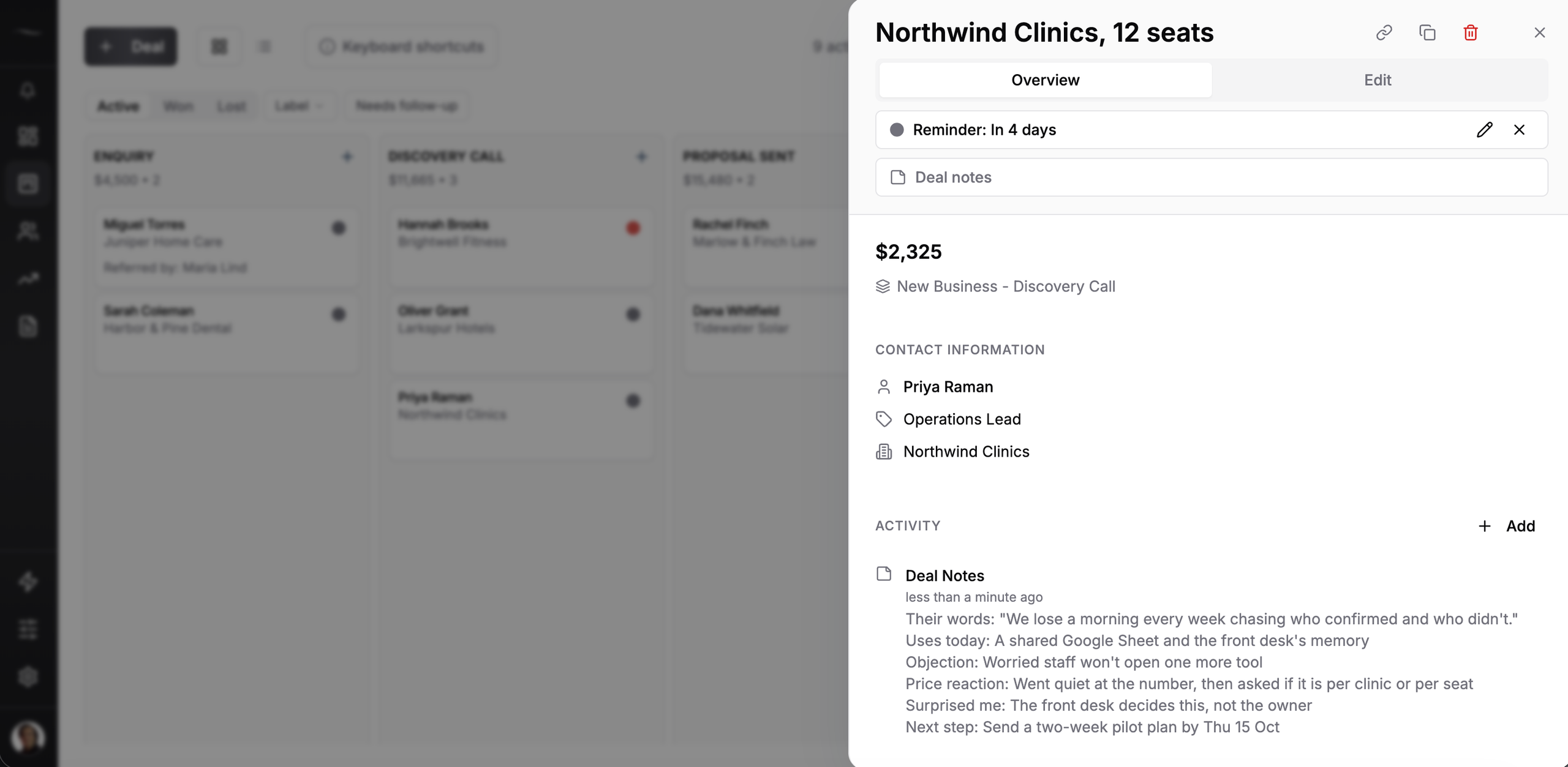
A card is a deal with no value, named after the person. Creating it also creates the contact and the company, so you type each name once.
If people sign up through your website, you can also point a separate “stay in touch” lead capture form at the Nurture pipeline, so those sign-ups land there instead of in sales.
3. Turn on Auto-reminder for the pipeline
In your Workspace settings, open the Automations tab, pick the Nurture pipeline and switch on Auto-reminder. Every new card then gets a follow-up reminder the moment it is created.
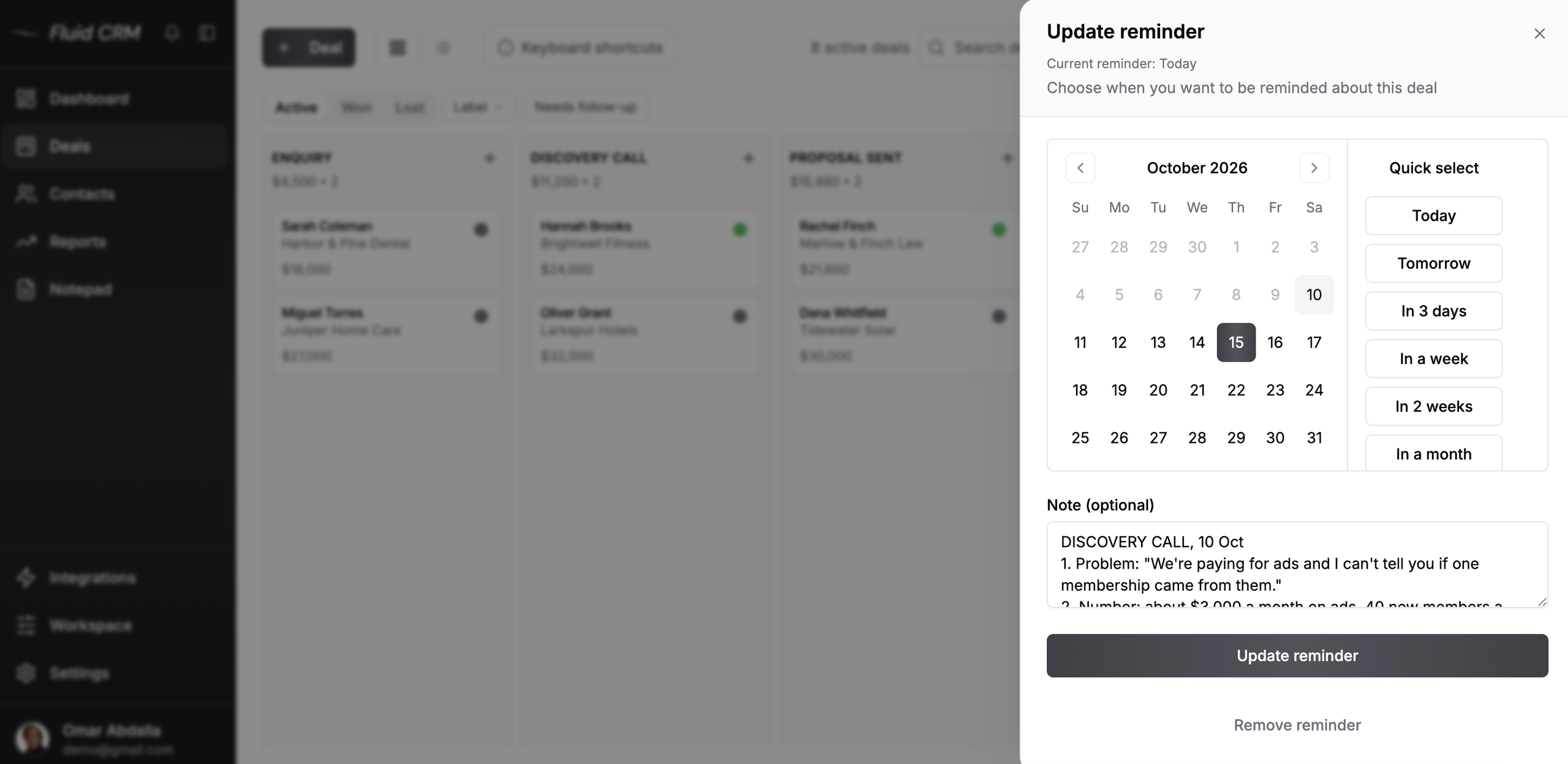
4. Set the right date on each card
Change the reminder to match the schedule table. Quick picks cover in 3 days, in a week, in 2 weeks and in a month, and you can pick any date on the calendar.
5. Move warm leads back with an automation
Set the cross-pipeline move automation on the Nurture pipeline so a card that reaches Ready for sales moves into your sales pipeline. The notes and history go with it.
A verified customer who coordinates a European coaching network of about 80 coaches uses the same move for training. “When they complete the programme, an automation moves them into the COACHES pipeline with all their history intact.”
Two limits that shape how you nurture
Each card holds one reminder at a time, set by date. So the next check-in date is yours to set after every message, which is why the checklist below ends with it, and a person needs a card before they can have a reminder at all.
Fluid CRM doesn’t send email, so every check-in goes out from your own inbox as a personal note. That suits nurturing, and you can log the message with the BCC address or ask Claude to add the note through the connector on days you don’t open the app. Our guide to Claude for sales has the prompts for that.
A Friday nurture checklist
Kon T., a CEO who reviewed Fluid CRM on G2, described the kind of setup this checklist assumes. “Fluid gives me a simple way to keep leads, deals, contacts, follow-ups and basic sales activity organized without the overhead of a larger CRM.”
- Read this week’s due reminders in the digest or on the Nurture board
- Check each card’s signal before you write (a new quarter, funding news, a new decider)
- Send each check-in with the reason they gave in the first line, then log it
- Drag anyone who replied to Talking again
- Mark lost anyone whose date has passed with two check-ins and no answer
- Set the next reminder on every card you touched
Signs a Nurtured Lead Is Ready for Sales
A lead is ready to move back when the thing that stopped them has changed. You don’t need a score to see it.
- They ask about price or start dates. That is a buying question, even when it sounds casual.
- The date they gave arrives and they reply. The budget opened or the project ended.
- A new decision maker appears. A new manager often means a new look at old plans.
- They reply with a question of their own. Anything beyond “thanks” means the conversation is open again.
- They come back through a form. The same person filling in a form a second time is asking to talk again. The form creates a new card, so copy anything new onto their nurture card and mark the extra one lost.
When any of these happens, drag the card to Ready for sales and the automation moves it into your sales pipeline. Then treat the next conversation like a fresh discovery call, because their situation has changed since the first one. Reply as fast as you would to a new inquiry, since the speed to lead rules apply to a returning lead too.
Happy clients can also add new people to the Not now column through introductions, and our guide on how to ask for referrals covers what to say.
FAQ
Following up is the short chase right after a conversation, when an answer is due. Lead nurturing starts once the person has said not yet. It runs over weeks or months, on a schedule tied to the reason they gave.
Nurture a lead until the date they gave you has come and gone without an answer. Two more check-ins after that date is a fair limit. If nothing comes back, close the card as lost and keep the history in case they return.
No. A list of a few dozen people who said not yet is small enough to handle by hand in one short session a week. Marketing automation pays off when you have thousands of contacts and someone whose job is to write the sequences.
Yes, with a separate nurture pipeline. Each person becomes a card with a reminder, because reminders in Fluid CRM live on deals rather than on contacts. An automation moves the card into your sales pipeline when they are ready.
Start With the Leads Who Already Said “Not Now”
Write down every person who told you “not yet” this year, the reason they gave and a date to write again. That list is your nurture pipeline, whether it lives on paper or in a consulting CRM. Fluid CRM costs $16 per seat a month or $144 per seat a year, with every feature in the one plan.
Start your 7-day free trial here, no credit card required.