

Choosing a CRM for agencies usually starts with a list of 10 to 16 tools sorted by features or team size. How clients find you matters more, because it decides what the CRM has to remember. A referral shop, an outbound shop and a design studio lose leads in different places.
The best CRM for agencies depends on how you win clients. Referral and retainer agencies need a date on every open conversation, outbound agencies need replies sent in automatically and project studios need a web form. Fluid CRM ($16 per seat a month) covers all three, and staffing firms add a recruiting system.
What a CRM for Agencies Actually Has to Track
Every agency tracks one pipeline, its own new business. That is the list of companies you are trying to sign, from first reply to signed contract. If you also generate leads for clients, you track a second kind of pipeline, one per client, so you can show each client what happened to the leads you sent.
Fluid CRM keeps both kinds in one workspace, each as its own pipeline. The pipeline switcher below lists a new business pipeline, a renewals pipeline, a client’s lead pipeline and a referral partner pipeline. Our agency CRM page shows how the boards look in practice.
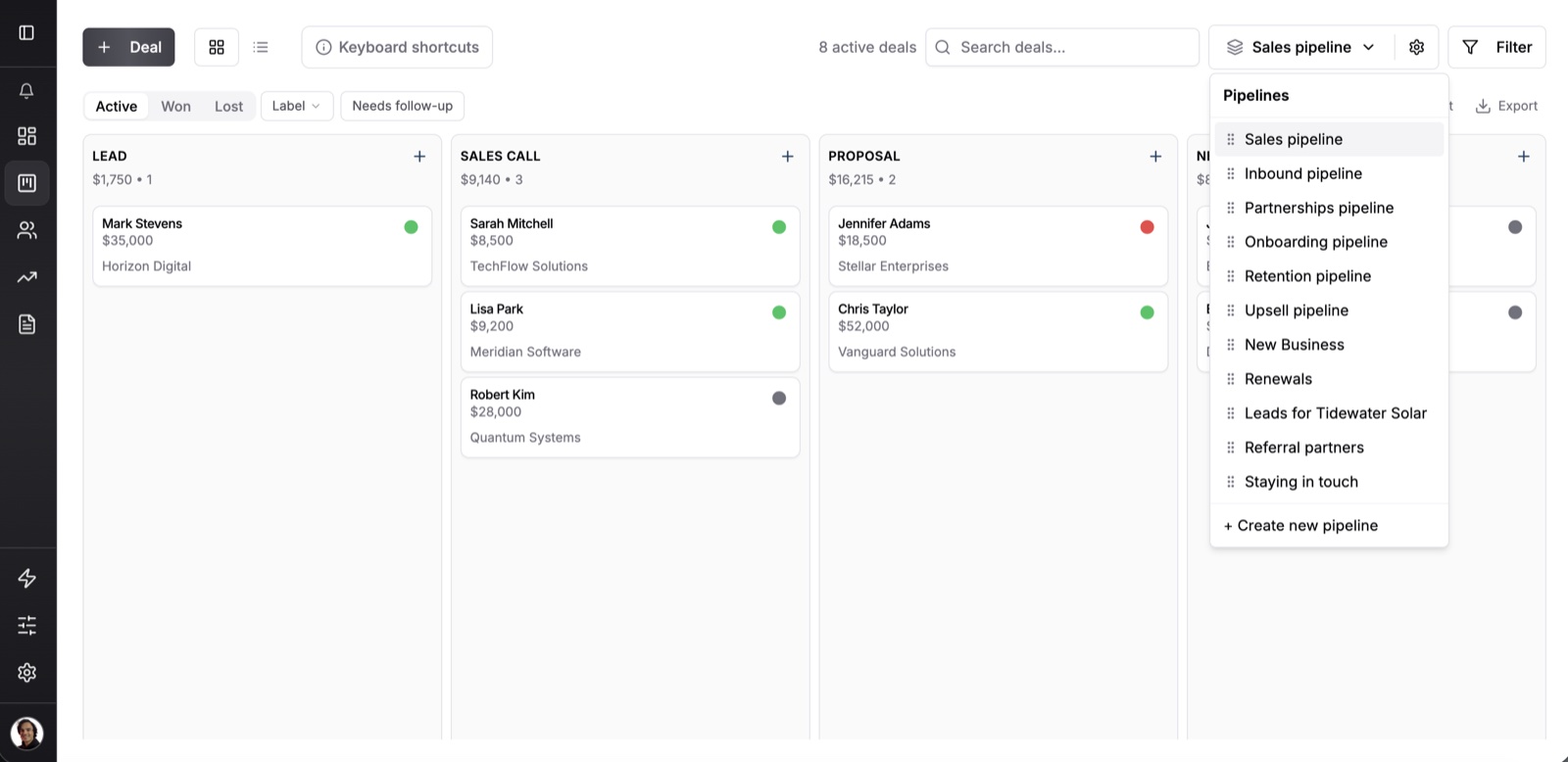
The stages inside each pipeline are the easy part, and our guide to the agency sales pipeline has templates by agency type. The hard part is keeping the board current in the weeks when client work fills every day. Leads die on the days nobody opens the CRM, so the tool has to take seconds to update, and an AI assistant connected to it can log calls and replies when nobody on the team has time.
CRM for Agencies Compared by How You Win Clients
Each row below is one way agencies win work, the tool that fits it and the one thing that tool does not do. The sections after the table give the short verdict for each type and link to a full guide.
| How you win clients | Pick | Starting price | Limitation |
|---|---|---|---|
| Referrals and retainers | Fluid CRM | $16 per seat a month | No proposals, contracts, invoices or client portal |
| Inbound content and email marketing | HubSpot Sales Hub | Free for 2 users, Starter $20 per seat a month | Professional costs $90 per seat a month billed annually, plus a one-time $1,500 onboarding fee |
| Outbound and lead generation | Fluid CRM, fed by your sending tool through the API | $16 per seat a month | No built-in dialer |
| Outbound, with email sent from inside the CRM | Pipedrive | Lite $14, Growth $39 per seat a month billed annually | Full email sync starts on Growth, not Lite |
| Project work, creative and web | Fluid CRM with a lead capture form | $16 per seat a month | Quotes, contracts and invoices stay in the tools you already use |
| Staffing and recruiting | Bullhorn for candidates, a sales CRM for client companies | Bullhorn Starter from $99 per user a month | Two systems the team has to keep in step |
| Reselling a CRM to your clients | GoHighLevel | Starter $97 a month with 3 client accounts | Built around client accounts, so it is more than you need for your own pipeline |
Fluid CRM is one plan with every feature in it, $16 per seat billed monthly or $144 per seat a year. There is no tier to outgrow, so the price in the table is the price a team of five pays per seat too.
How to tell which row is yours
Open your last 10 signed clients and write next to each one how the first conversation started: a referral, a reply to outreach, an enquiry from your site or a job order. If six or more share one source, pick the tool for that row. If they are spread out, pick for the source you want to grow next year, because that is where the new leads will pile up.
Most small agencies land on two sources, usually referrals plus one active channel such as outbound or LinkedIn. That is still one pipeline, with a label for the source on each deal, not two tools. For help choosing that second channel, our guide to agency lead generation compares six of them.
Referral and Retainer Agencies (Marketing, SEO, PR)
Most marketing, SEO and PR agencies win work through people who already know them. Those leads rarely say no, they say “maybe after Q1”, and nobody writes down when Q1 ends.
The CRM has to put a date on every one of those conversations and a renewal date on every retainer.
That is most of what a referral agency needs, and it is why a simple pipeline beats a big platform here. Nicolas Virtsonis, who runs a B2B marketing agency, described the daily use in his G2 review as “incredibly fast for B2B high-value pipeline building.” He had used Sugar, Zoho, Pipedrive and Salesforce before.
HubSpot fits when inbound content is your engine and you want marketing emails and forms in the same tool. For the full comparison of nine tools, the renewal pipeline and what 5 and 10 seats cost, read our guide to the best CRMs for marketing agencies.
Outbound and Lead Generation Agencies
An outbound agency lives on replies. The CRM’s job is to turn every positive reply from Smartlead or Instantly into a deal without anyone copying it across. If you also book calls for clients, you want a separate pipeline per client.
Austin Verner runs Cold Emailers, a cold email agency, and moved off Google Sheets for exactly this reason. His testimonial lists what sold him: “An easy deal view, reminders, and our interested leads from Smartlead auto-created via API.” Fluid CRM includes an API and webhooks in its one plan, so the sending tool or Make creates the deal for you.
Fluid CRM has no built-in dialer, so a team that calls down a list all day is better served by a CRM with a phone inside it. Read the best CRM for outbound agencies for the setup with setters and client pipelines, or the best CRM for cold email agencies for the reply workflow from sequencer to pipeline.
Project-Based Studios (Creative and Web Design)
Creative and web studios have a timing problem. During a big project nobody touches the pipeline, so when the project ships there is no next one booked. The fix is two small habits that keep running during production weeks.
The first is a lead capture form on your portfolio site that creates the contact and the deal for you, so an enquiry on Saturday is waiting on Monday. The second is a reminder on every open quote, which the daily email lists each morning.
Keep proposals, contracts and invoices in the tools you already use. Our guide to the best CRM for creative agencies covers branding, content and video teams. Solo designers and small studios should read the best CRM for web designers, which compares seven tools by studio size.
When Team Size or Staffing Changes the Answer
Team size and staffing are the two things that change which agency CRM fits. For team size, ask whether your whole team can name the three deals most likely to close this month without opening a tab. If not, the problem is rarely a missing feature.
My old outbound agency, Fenixtal, sent leads to marketing agencies, outbound agencies and web designers, and the leads that died almost never died on the sales call. They died in the weeks after, in a spreadsheet that got messy or a big CRM nobody liked opening.
That is why most agencies under 10 people do not need an “agency operating system” with time tracking, resourcing and invoicing built in. They need one pipeline the team opens every day, next to the delivery and billing tools they already have.
Past 10 to 15 people, when you bill by the hour and want profit per project in the same place as the sale, an all-in-one platform such as Productive starts to make sense. If you want to give each client their own CRM under your brand, that is GoHighLevel’s job. The full size-by-size breakdown is in our guide to the CRM for small agencies.
Staffing agencies are the one type where a single tool rarely fits. Candidates belong in a recruiting system such as Bullhorn, which is built around CVs, placements and job orders, and the client companies you are trying to win belong in a sales pipeline.
Recruiters who also do the selling often try to run both from the recruiting system and find that client follow-ups end up mixed in with candidate tasks. Our guide to the best CRM for staffing agencies splits nine tools across both sides.
FAQ
Yes, because referral leads are the ones that wait longest. A referral who says “talk in March” has no date anywhere unless you write one down. A simple pipeline with a reminder on each deal is enough.
Yes, if it allows more than one pipeline on your plan. Keep your own new business in one pipeline and give each client a separate pipeline for the leads you generate. Fluid CRM includes unlimited pipelines on its one plan.
It is free for up to 2 users, so it works for a founder and one partner. The bill starts when a third person joins, at $20 per seat a month on Starter. Check what you need from Professional before you plan around it.
Only if you also sell GoHighLevel accounts to clients. It is built around client accounts, funnels and texting. For tracking your own new business, a plain sales pipeline is faster to set up and to keep current.
A CRM tracks work you have not won yet, and project management software tracks work you have already sold. Some agency platforms do both in one tool, which suits larger teams that bill by the hour. Under 10 people, most agencies keep the two apart and use a simple tool for each.
Which Agency CRM to Start With This Week
Start with how your last 10 clients found you, then read the guide for that type. If most came from referrals, outbound or projects and your team is under 10, put your open deals into one pipeline this week and give each one a date. Fluid CRM is built for that, at $16 per seat a month with every feature included.
Start your 7-day free trial here, no credit card required.