

Search for how to get clients and you get lists of 15 tactics, from guest posts to paid ads. You are one person with client work to deliver and a few free hours a week, so a list that long is no help.
To get clients as a one-person business, write a list of 30 named people, starting with those who already know your work. Contact five a week, add ten new people through one outbound channel and follow up three times. Keep every reply in a tracker or a tool like Fluid CRM, with a date for the next step.
I ran Fenixtal, an outbound agency that booked 1,250+ sales calls for its clients. Fenixtal created 12M€+ in pipeline for 50+ B2B clients, and they included business consultants, sales coaches and web designers. This guide is the short version of that work, cut down to what one person can keep up.
The five and ten are our own recommendation, because no agreed figure exists for how many people to contact.
Where Clients Come From for a One-Person Business
Clients come from people, and the people who know you best say yes soonest.
MBO Partners asks independent workers in the US how they find work. In its 2024 State of Independence report, 53% named word of mouth, which made it the most cited way. 43% named social media and 29% named online talent marketplaces.
A one-person business has five sources of clients, and they are listed here by how well the person already knows you.
| Source | Who it is | When to use it |
|---|---|---|
| People who know your work | Former colleagues, managers and people you have helped for free | First, from day one |
| Past clients | Anyone who has paid you before | As soon as you have one |
| Referrals | People your clients and contacts can introduce | After every good result |
| One outbound channel | Strangers who fit, reached by LinkedIn or cold email | When the first three are in motion |
| One public place | The single place where you post or answer questions each week | Alongside outbound, at a low dose |
The order matters more than the list. In my experience a person who has seen your work answers far sooner than a stranger does, so the top three rows deserve your first hours every week.
Leave the website redesign, the newsletter and the ads until you have written to every person in the top three rows, because none of those projects starts a conversation this month.
Start With a List of 30 Named People
Getting clients begins with a list of names, and 30 is enough to start. A name is a real person you could write to today, so “marketing managers in Austin” does not count and “Dana from my old team” does.
Open a blank page and fill it from three groups.
People who already know your work
Write down former colleagues, old managers, people you studied with and anyone you have helped without charging. They have seen how you work, which is the one thing a stranger cannot check.
Tell these people what you do now and ask who they would talk to in your place, without asking them to hire you.
Past clients
Anyone who has paid you once is more likely to pay you again than a stranger is. Add every past client to the list, including the small projects and the ones from two years ago.
A check-in with a past client is its own skill, and our guide on how to keep in touch with clients has the messages and the timing.
People who can introduce you
Some people on your list will never buy and still know five people who might. Think of an accountant whose clients need your service, or a designer who gets asked for the thing you do.
The wording of that request is covered in our post on how to ask for referrals, so this guide gives you only the short version further down.
Add one outbound channel and one public place
When the list is in use, add strangers through one channel only. Choose LinkedIn if you sell to a few hundred companies and your buyers are active there, and choose cold email if your market is thousands of companies.
Our guide on how to find clients on LinkedIn explains the first option. The cold email outreach playbook explains the second.
Then pick one public place and show up there every week. It can be LinkedIn posts, answers in one community or a short email to people who asked for it.
Keep the list somewhere you will open again. A notes app works for a week, a spreadsheet works for months and a CRM for solopreneurs is for the point where the list has more open conversations than you can hold in your head.
A Weekly Routine One Person Can Keep
A routine only works if you can keep it in a busy client week, and this one takes about three hours.
How many people should you contact each week?
We recommend 15 people a week for a one-person business, which is five who already know you and ten who are new. Treat it as a starting point and raise or lower it after a month.
| What | How many a week | Time |
|---|---|---|
| Messages to people from your list of 30 | 5 | 30 minutes |
| New people through your one outbound channel | 10 | 60 minutes |
| One post or answer in your public place | 1 | 30 minutes |
| Follow-ups that are due | All of them | 30 minutes |
| Friday review of every open conversation | 1 | 20 minutes |
Five a week uses up a list of 30 in six weeks, so add every new past client and introduction to it as you go.
To check the number against your own goal, work backwards. As an example, say you want one new client a month, you win one proposal in three and one conversation in five leads to a proposal. That is 15 conversations a month, so count your replies after four weeks and adjust the ten.
The follow-ups are the row people skip. When someone does not answer, write again on day 3, day 9 and day 20, and add something new each time. After the third one, set a date a few months ahead and move on.
Count the people you have spoken to about work in the last 60 days. Can you say what the next step is with each of them?
If the honest answer is “not really”, you do not need more leads yet. You need the Friday review, which is 20 minutes of reading every open conversation and giving each one a next step with a date.
What To Say in the First Message for Each Source
A first message has one job, which is to get a reply. Each message below is short, says why you are writing to this person and ends with a question they can answer in one word.
Put your own facts where the square brackets are, and never invent a result.
1. To a former colleague or contact
Hi [Name], it’s been a while since we worked together at [company], and I wanted to tell you what I’m doing now.
I’ve started working for myself, and I help [type of business] with [problem]. I’m taking on [two] new clients this quarter.
I’d value your view on who I should be talking to. Are you open to a 15-minute call next week?
2. To a past client
Hi [Name], it’s been [six months] since we finished [project], and I’ve been wondering how [the thing you delivered] is holding up.
I have room for one more project in [month], so I wanted to ask you before I offer it to anyone else. Is there anything on your list that I could help with?
3. To a client who can introduce you
Hi [Name], I’m glad [result] worked out for you.
I can send you two lines to forward, and it’s fine if nobody comes to mind. Do you know one [type of person] who is dealing with [problem]?
For a contact who was never a client, open with one line on what you do now.
4. To a new LinkedIn connection
Send this after they accept your connection request.
Hi [Name], thanks for connecting. I help [type of business] with [problem], and I’ve been following what [their company] is doing with [something specific].
I’ve put together two examples of how [similar businesses] handled it. Want me to send them?
5. To a stranger by cold email
Use a plain subject line such as [Their company] and [problem].
Hi [Name], I work with [type of business] that [problem in their own words], and I think [their company] might be dealing with the same thing.
I recently helped [similar client] get [your result] in [time frame], and the main change we made together was [what you did, in a few words].
I wrote up how it worked as a one-page example, and it’s short enough to read in two minutes between calls.
Want me to send it over to you?
Only offer something you already have. If the two examples or the one-page example do not exist yet, write them before you send the message or offer a short call.
Where Solo Businesses Lose Clients Who Already Replied
A solo business often loses a client right after the first reply. Someone writes “sounds interesting, let’s talk next month”, you answer, a client project takes over your week and the month passes.
Nobody said no, but the conversation had no next step with a date on it, so you had no reason to open it again.
In a study of 12 million outreach emails by Backlinko and Pitchbox, one follow-up lifted replies by 65.8%.
At Fenixtal we kept following up for clients until there was a clear yes or no, and one sales call was booked nine months after the first message. A follow-up that far out only happens if the date is written down.
Two habits keep an interested person from being forgotten.
- Give every reply a next step and a date on the same day. Write it down before you close the email, even if the step is “ask again in March”.
- Follow up on days 3, 9 and 20 when they stop answering. Our templates for a follow-up email after no response give you the wording for each one.
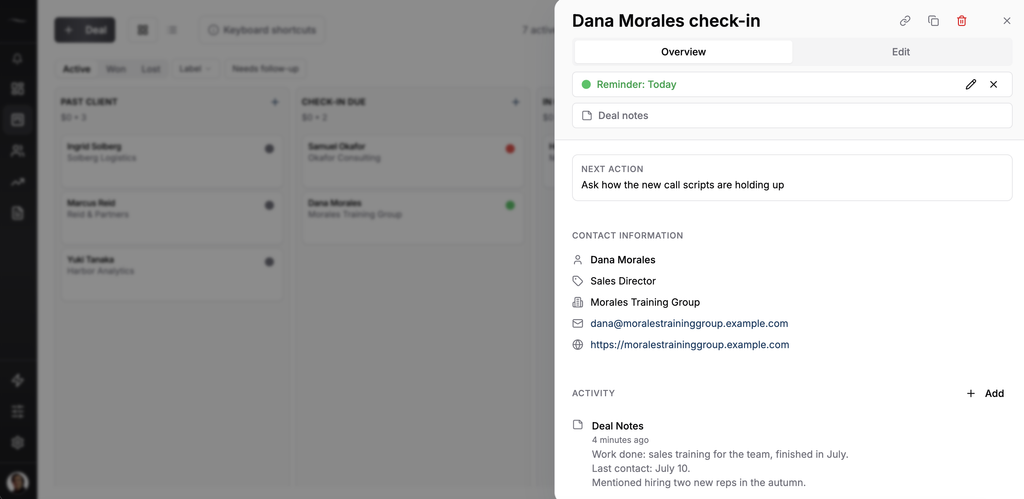
The screenshot shows what one conversation needs, which is who the person is, what was said last and the date you will write again.
A Client Tracker You Can Copy (and When To Move It)
You do not need software to start. A spreadsheet with eight columns holds everything in this guide.
| Column | What goes in it |
|---|---|
| Name | The person, not the company |
| Company | Where they work |
| Source | Past client, referral, LinkedIn, cold email or your public place |
| Last contact | The date you last wrote or spoke |
| Next step | What you will do next, in a few words |
| Next step date | The day you will do it |
| Status | Contacted, Replied, Call booked, Proposal sent, Won or Not now |
| Notes | What they said, in their own words |
Sort the sheet by “Next step date” every morning and the top rows are your work for the day. If you want a ready file with these columns filled in as an example, use our client list template.
When a tracker is enough
Stay on Google Sheets or Excel while you open the sheet every working day and no next step date has slipped past you.
When to move it into a pipeline
Two signs tell you the sheet has stopped working. One is a missed date, where you find a next step that was due two weeks ago. The other is a second list, such as a notes app or starred emails that hold the people the sheet does not.
At that point the same rows fit a pipeline with four stages, which are Lead, Call booked, Proposal sent and Won. Each person becomes a card that you move from one stage to the next.
This is where Fluid CRM helps. Every card is a deal with its notes, its history and one reminder with a date. A daily email digest lists the reminders that are due, so you do not have to remember to sort anything.
Tim Chorlton handles his own enquiries, works with one external salesperson and moved over from spreadsheets. “I am a ‘one-man-band’ but I have an external sales person and also handle my own enquiries. I have used Fluid to pull the ‘warm leads’ out of the spreadsheet swamp so I can focus on them.”
You can bring your tracker in with a CSV import that reads the contact, company, value, stage, reminder date and notes. Fluid CRM costs $16 per seat a month or $144 per seat a year, with every feature included.
Know the limits before you try it. A deal holds one contact and one reminder at a time, and email is logged by BCC with no automatic sync. Fluid CRM sends nothing to your prospects, and it has no invoices, proposals or scheduling.
How To Get Clients FAQ
Start with the top of your list of 30, the people who have already seen your work. Tell them what you do now, who you help and that you are taking on clients. A first client often comes from that group or from someone they introduce.
Messages to people who know you can lead to a conversation within days. Strangers can take weeks or months, because many of them answer only after a follow-up. Plan for at least three months of the weekly routine before you judge it.
No. A website helps people check you after they have heard of you, but it does not start conversations on its own.
A One-Week Plan To Get Clients
Here is the whole method as one week of work.
- Monday. Write your list of 30 named people and copy the eight tracker columns into a spreadsheet.
- Tuesday. Send five messages to people who already know your work, using templates 1 to 3.
- Wednesday. Pick LinkedIn or cold email and contact ten new people with template 4 or 5.
- Thursday. Post once in your one public place, then answer every reply and give each one a next step with a date.
- Friday. Spend 20 minutes on every open conversation and give each one a next step with a date, starting with the day 3 follow-up.
Repeat the week, and move the tracker into a pipeline when a date gets missed. Fluid CRM is the CRM for solopreneurs we built for that moment, with one board, a reminder on every deal and nothing extra to look after.
Start your 7-day free trial here, no credit card required.